 meta-llama /
Meta-Llama-3.1-8B-Instruct-Turbo
| Tier | Input | Output | Cached input |
|---|---|---|---|
FlexLearn more | 5.76 | 11.52 | — |
Llama 3.1 8B carries the same 131,072-token window as the seventy-billion-parameter model released beside it — Meta extended the context across every size at once rather than reserving it for the large ones. Eight billion parameters with a very long window is an unusual combination, and it is what made this model the default foundation for open fine-tunes: small enough to train on accessible hardware, long enough to be useful. Meta's own Llama Guard 3 safety classifier is built on these weights. Eight supported languages, and a knowledge cutoff of December 2023.

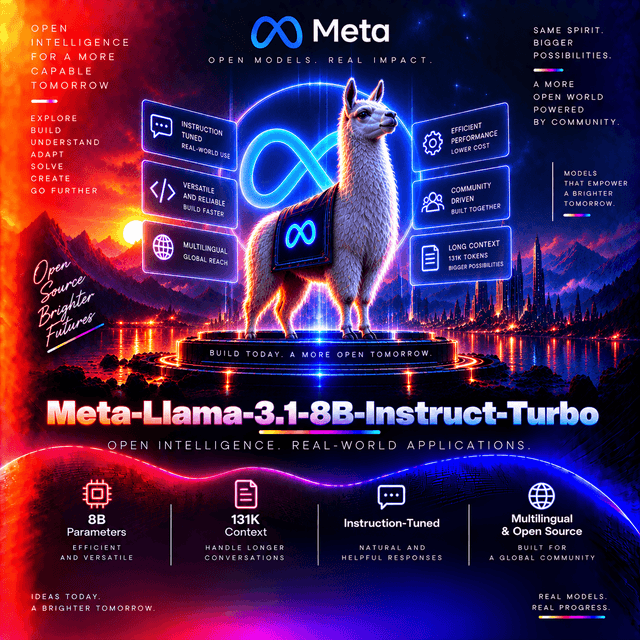
Llama 3.1 8B Instruct
Eight billion parameters, a hundred and thirty-one thousand tokens, and the base a great many things were built on.
The Window Did Not Shrink With the Model
The detail that defines this release, and it is easy to take for granted now.
| Llama 3 8B | Llama 3.1 8B | Llama 3.1 70B | |
|---|---|---|---|
| Context | 8,192 | 131,072 | 131,072 |
Sixteen times the previous generation's window, on an eight-billion-parameter model.
And identical to the seventy-billion-parameter model released beside it. Meta extended context across the entire family at once — 8B, 70B, and 405B, each in base and instruct form, all at 128K.
That was not the obvious choice. Long context is expensive in memory, and the conventional move is to reserve it for the large models where the capability is most usable. Putting 131,072 tokens on a model that runs on a consumer card is a different decision.
Grouped-query attention is what made it affordable — Meta name it as the reason: an efficient representation that helps with longer contexts by keeping the key-value cache manageable as input grows. On a small model that ratio is the difference between a long window fitting and not.
What the combination produced. A model small enough to fine-tune on accessible hardware, cheap enough to run at volume, and long enough to hold a codebase or a corpus. That is why so much of the open ecosystem was built on it.
Llama Guard 3 Is Built on These Weights
Worth knowing, and it is specific to this size.
Meta's Llama Guard 3 safety classifier is fine-tuned on Llama 3.1 8B, released alongside the family together with Prompt Guard.
Read what that implies. The moderation layer Meta recommend in every model card — the one referenced as the deployer's safety tooling across the whole Llama line — has these weights underneath it.
And it says something about what eight billion parameters is enough for. Classification against a defined taxonomy does not need frontier capability; it needs consistency, speed, and a footprint that makes running it on every request affordable. This model was judged sufficient for the job Meta's own products depend on.
For your own use, the parallel holds. Tasks that are classification-shaped — routing, tagging, triage, extraction against a fixed schema — are exactly what a model this size does well, and the long window means the thing being classified can be substantial.
Specifications
| Model ID | meta-llama/Meta-Llama-3.1-8B-Instruct-Turbo |
| Parameters | 8B |
| Type | Auto-regressive, optimised transformer |
| Attention | Grouped-Query Attention |
| Context length | 131,072 tokens |
| Input | Multilingual text |
| Output | Multilingual text and code |
| Pre-training | 15T+ tokens |
| Knowledge cutoff | December 2023 |
| Post-training | SFT + RLHF, 25M+ synthetic examples |
| Languages | 8 |
| Licence | Llama 3.1 Community License |
| Released | July 2024 |
| Developer | Meta |
Languages: English, German, French, Italian, Portuguese, Hindi, Spanish, and Thai.
Training cost, for scale: 1.46 million GPU hours for this model, against 7.0 million for the 70B and 30.84 million for the 405B — 39.3 million across the family.
Post-training used publicly available instruction datasets plus over 25 million synthetically generated examples, with supervised fine-tuning followed by reinforcement learning from human feedback. Meta developed LLM-based classifiers to filter and curate the data mix — which is what makes twenty-five million synthetic examples viable rather than harmful.
Note that the post-training scale did not shrink with the model. The same instruction data and the same alignment pipeline were applied across the family.
Provider suffixes such as -Turbo are hosting conventions rather than Meta's naming, usually
encoding a quantisation or a serving tier.
Capabilities
| Capability | Value |
|---|---|
input_types | text |
output_types | text, code |
image_input | Not supported |
context_window | 131072 |
reasoning | No separate reasoning trace |
streaming | Supported |
tool_calling | Supported |
structured_output | Supported |
requires_prompt | Yes — text prompt required |
⚠️ Knowledge Ends December 2023
The constraint that decides how you use this model for anything factual — and it bites harder on a small model than a large one.
December 2023 is nearly three years before now. Library versions, API surfaces, product names, regulations, prices, and people in roles have all changed, and the model will answer about them with complete confidence.
Why it matters more at eight billion parameters. A large model's recall is broader and more reliable within its cutoff; a small model's is thinner to begin with. Asking this one to answer from memory compounds two weaknesses — limited recall and stale recall.
Which makes grounding the design rather than a precaution. Retrieval moves the model from recalling to reading, and reading is where an eight-billion-parameter model performs closest to a much larger one.
And 131,072 tokens is exactly what makes that practical here. The window that seemed disproportionate for a small model is what lets you supply enough material that memory rarely gets consulted.
Tell it the date. One computed line in the system prompt removes a category of quiet error.
⚠️ Eight Languages, and Arabic Is Not One
English, German, French, Italian, Portuguese, Hindi, Spanish, Thai.
No Arabic. No Chinese. No Japanese. No Korean. No Russian.
The model will produce text in other languages — it has seen them — but Meta do not support that, which means the quality was not measured and the behaviour was not tuned. On a small model that gap widens, because there is less capacity absorbing what the training did not explicitly cover.
Meta's own later generation reversed this. Llama 4 lists twelve languages with Arabic first.
If your traffic is outside the eight, that is a reason to choose a different model rather than a detail to work around — and there are models in this catalogue at similar size supporting a hundred languages or more.
⚠️ Read the Licence
The Llama 3.1 Community License — a custom commercial licence, not Apache or MIT.
It carries an attribution requirement and a monthly-active-user threshold above which separate terms apply. The terms are specific to this version rather than inherited from earlier releases.
Meta shipped safety tooling alongside this release — Llama Guard 3, built on this very model, and Prompt Guard.
Deploying them is a decision, and on a public-facing path it is the right one. A small model is not a less consequential one when it sits in front of users.
It Answers Directly
No thinking mode, no effort parameter, no reasoning_content field.
max_tokens covers the answer alone — nothing shares it.
Latency tracks input and output length, not how hard the model judged the question. At eight billion parameters that latency is low enough for the model to sit inline in a request path rather than behind a job queue — which is most of why you would choose it.
Using Llama 3.1 8B on DEVUP AI
Base URL: https://api.devupai.com/v1 · Model ID: meta-llama/Meta-Llama-3.1-8B-Instruct-Turbo
Python
import os
from openai import OpenAI

client = OpenAI(
    api_key=os.environ["DEVUP_API_KEY"],
    base_url="https://api.devupai.com/v1",
)

response = client.chat.completions.create(
    model="meta-llama/Meta-Llama-3.1-8B-Instruct-Turbo",
    messages=[
        {"role": "user", "content": "Hello world!"}
    ],
    max_tokens=1024,
)

print(response.choices[0].message.content)
Node.js
import DevupAI from "devupai";

const client = new DevupAI({
  apiKey: process.env.DEVUP_API_KEY,
});

async function main() {
  const response = await client.chat.completions.create({
    model: "meta-llama/Meta-Llama-3.1-8B-Instruct-Turbo",
    messages: [{ role: "user", content: "Hello world!" }],
    max_tokens: 1024,
  });

  console.log(response.choices[0].message.content);
}

main();
cURL
curl -X POST "https://api.devupai.com/v1/chat/completions" \
  -H "Authorization: Bearer $DEVUP_API_KEY" \
  -H "Content-Type: application/json" \
  -d '{
    "model": "meta-llama/Meta-Llama-3.1-8B-Instruct-Turbo",
    "messages": [
      { "role": "user", "content": "Hello world!" }
    ],
    "max_tokens": 1024
  }'
Classification at Volume
The shape this model suits best, and the one Meta's own safety classifier demonstrates.
import json

SYSTEM = """Classify the support ticket into exactly one category.

Categories: billing, delivery, technical, account, other.

Rules:
- Reply with a single JSON object: {"category": "...", "confidence": "high"|"low"}
- Use "low" confidence when the ticket could reasonably belong to two categories, or when it does
  not clearly belong to any.
- Never explain. JSON only."""


def classify(ticket: str) -> dict:
    """Classify a ticket, with a confidence signal for routing."""
    response = client.chat.completions.create(
        model="meta-llama/Meta-Llama-3.1-8B-Instruct-Turbo",
        messages=[
            {"role": "system", "content": SYSTEM},
            {"role": "user", "content": ticket},
        ],
        max_tokens=64,
        temperature=0,
    )

    raw = response.choices[0].message.content

    try:
        return json.loads(raw)
    except json.JSONDecodeError as exc:
        raise ValueError(f"model did not return parseable JSON: {raw[:200]}") from exc
The confidence field is the part worth copying, and it matters more on a small model than a large one.
An eight-billion-parameter model will classify anything you give it, including tickets that genuinely belong to two categories or to none. Without a way to express doubt, it picks one and you have no signal that it was a guess.
With it, you get a routing rule for free. High-confidence classifications proceed; low-confidence ones go to a person, or to a larger model. That is a two-tier pipeline built from one extra field.
temperature=0 and a small max_tokens. Classification has one correct answer, and a sixty-four
token ceiling guards against a malformed response running long.
Grounded Question Answering
Where the long window turns a small model into a useful one.
from datetime import date

GROUNDED = f"""Answer only from the material provided below. Quote the passage supporting each
statement. Where the material does not contain the answer, say so plainly and stop — do not fill the
gap from general knowledge.

Your training data ends in December 2023. The current date is {date.today().isoformat()}. Treat
anything you recall about software versions, APIs, prices, regulations, or people in roles as
potentially out of date, and say so when you rely on it."""

response = client.chat.completions.create(
    model="meta-llama/Meta-Llama-3.1-8B-Instruct-Turbo",
    messages=[
        {"role": "system", "content": GROUNDED},
        {"role": "user", "content": f"{documents}\n\nQuestion: {question}"},
    ],
    max_tokens=4096,
    temperature=0.2,
)
This is the configuration that makes an eight-billion-parameter model competitive. Reading is a much easier task than recalling, and the gap between a small model and a large one narrows considerably when the answer is in front of both of them.
The quote requirement is the enforcement. A model required to quote cannot invent — and on a small model with thin recall, that constraint is doing more work than it would on a large one.
Supply generously. With 131,072 tokens available, there is rarely a reason to send a summary when you could send the source.
Tool Calling
import json

TOOLS = [
    {
        "type": "function",
        "function": {
            "name": "lookup_order",
            "description": "Return order status, line items, and delivery events for an order ID.",
            "parameters": {
                "type": "object",
                "properties": {"order_id": {"type": "string"}},
                "required": ["order_id"],
            },
        },
    },
]


def lookup_order(order_id: str) -> dict:
    """Replace with your real data access layer."""
    raise NotImplementedError


HANDLERS = {"lookup_order": lookup_order}

thread = [
    {
        "role": "system",
        "content": (
            "You are a support agent. Look facts up with the tools provided rather than assuming "
            "them. If the request does not identify a specific order, ask before calling anything. "
            "Never guess an order ID."
        ),
    },
    {"role": "user", "content": "My order shows delivered but nothing arrived."},
]

CEILING = 10

for step in range(CEILING):
    response = client.chat.completions.create(
        model="meta-llama/Meta-Llama-3.1-8B-Instruct-Turbo",
        messages=thread,
        tools=TOOLS,
        max_tokens=2048,
        temperature=0.2,
    )

    message = response.choices[0].message
    thread.append(message)

    if not message.tool_calls:
        print(message.content)
        break

    for call in message.tool_calls:
        handler = HANDLERS.get(call.function.name)
        if handler is None:
            outcome = {"error": "unknown tool", "name": call.function.name}
        else:
            try:
                arguments = json.loads(call.function.arguments or "{}")
            except json.JSONDecodeError:
                outcome = {"error": "malformed arguments", "raw": call.function.arguments}
            else:
                try:
                    outcome = handler(**arguments)
                except Exception as exc:
                    outcome = {"error": type(exc).__name__, "detail": str(exc)}

        thread.append({"role": "tool", "tool_call_id": call.id, "content": json.dumps(outcome)})
else:
    print(f"Stopped at the {CEILING}-step ceiling.")
Note the separate handling for malformed arguments. On a small model, tool-call JSON is a more common failure than on a large one — and returning the malformed string as data lets the model see what it produced and correct it, rather than the loop crashing.
"Never guess an order ID" is worth the clause. A model instructed to look things up, with no identifier available, will sometimes produce a plausible-looking one. The explicit prohibition is cheaper than validating every call.
As a Fine-Tuning Base
The role this model played across the open ecosystem, and still plays.
Eight billion parameters is trainable on accessible hardware. A full fine-tune fits on a single large card; LoRA fits on much less.
A long window survives the fine-tune. Training a small model on your own data does not cost you the 131,072 tokens, which means a specialised model can still read a corpus.
And the licence permits it. Commercial fine-tuning is allowed under the Llama 3.1 Community License, subject to its attribution requirement and user threshold.
When fine-tuning beats prompting. The task is narrow, its definition is stable, you have a few hundred to a few thousand good examples, and volume is high enough that saving input tokens on every call compounds. A long system prompt repeated across a million requests is a permanent tax; fine-tuning moves that instruction into the weights.
When it does not. The definition changes often, the examples are few, or a larger model simply solves the problem without training.
Where It Fits
Classification, routing, tagging, and triage at volume — the shape Meta's own safety classifier demonstrates on these weights.
Grounded question answering, where the long window lets a small model read rather than recall.
Inline request paths, where latency at eight billion parameters is low enough to sit between a user and a response.
The first tier of a two-model pipeline, escalating low-confidence cases to something larger.
Local and edge deployment, where eight billion parameters is the difference between running and not.
Fine-tuning, which is what much of the open ecosystem used it for.
Extraction against a fixed schema, with a confidence signal for the ambiguous cases.
Not for complex reasoning. Eight billion parameters, no thinking mode.
Not for current factual knowledge. December 2023, with thin recall to begin with.
Not for Arabic, Chinese, Japanese, Korean, or Russian.
Not for images. Text only.
Practical Notes
Ground everything factual. On a small model with an old cutoff, memory is the weakest path.
Use the window generously — it is what makes this model competitive on reading tasks.
Add a confidence field to classification output, and route on it.
Use temperature=0 and tight max_tokens for classification.
Handle malformed tool-call arguments separately from handler failures.
Forbid guessing identifiers explicitly.
Inject the current date and require the model to flag training-knowledge answers.
Check whether your users' languages are among the eight.
Consider fine-tuning if your task is narrow, stable, and high-volume.
Read the Llama 3.1 Community License — attribution and a user threshold both apply.
Limitations
Eight billion parameters. Capable at classification, extraction, and grounded reading; bounded on anything requiring depth.
Knowledge ends December 2023, and recall at this size was thin before it went stale.
Eight supported languages, without Arabic, Chinese, Japanese, Korean, or Russian — and the gap outside them is wider on a small model.
Text only. No image, audio, or video input.
No reasoning mode.
Tool-call formatting is less reliable than on larger models. Validate arguments, and handle malformed JSON as a case rather than an exception.
A custom commercial licence, with attribution and a monthly-active-user threshold.
A July 2024 model. Foundational, widely built upon, and three generations behind Meta's current family.
Confident answers with no visible reasoning — and on a small model, confidence and correctness are less correlated than on a large one. Ground the work and require an explicit way for it to say it does not know.


