Model Library
Browse and deploy state-of-the-art AI models through the DEVUP Gateway.
Loading models...
Model Library
Browse and deploy state-of-the-art AI models through the DEVUP Gateway.
Browse and deploy state-of-the-art AI models through the DEVUP Gateway.

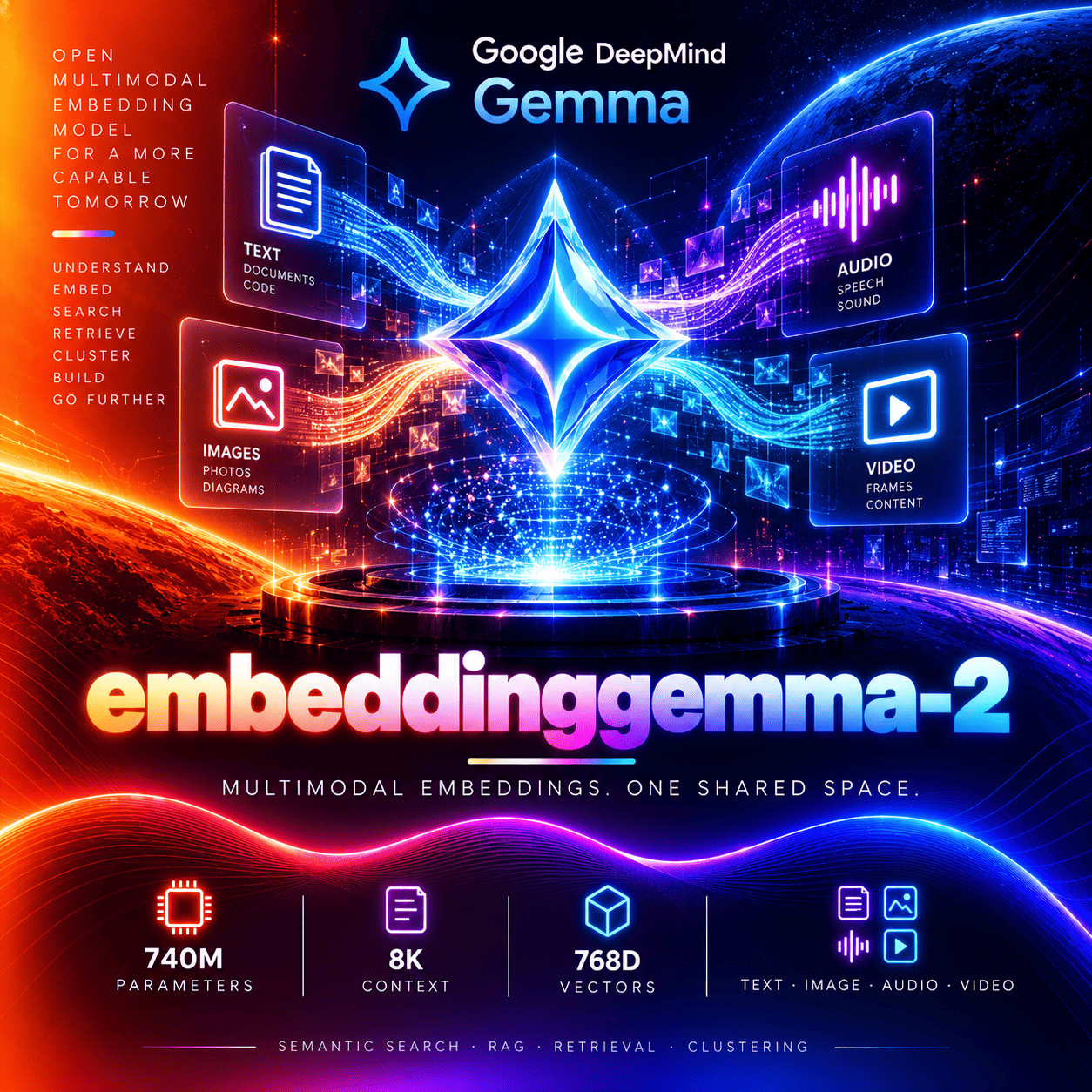
EmbeddingGemma 2 places text, code, images, video, and audio in one 768-dimensional vector space, so a text query can retrieve a photograph, a video clip, or a recording directly, with no separate model per modality. It carries 740 million parameters, but its vision and audio encoders load independently — a text-only deployment runs at 270 million. Against its predecessor, multilingual text quality is essentially unchanged while code retrieval rose by roughly fourteen percent, and every other modality is new. Vectors truncate from 768 down to 128 dimensions, though the cost of shrinking them depends heavily on what you are embedding.

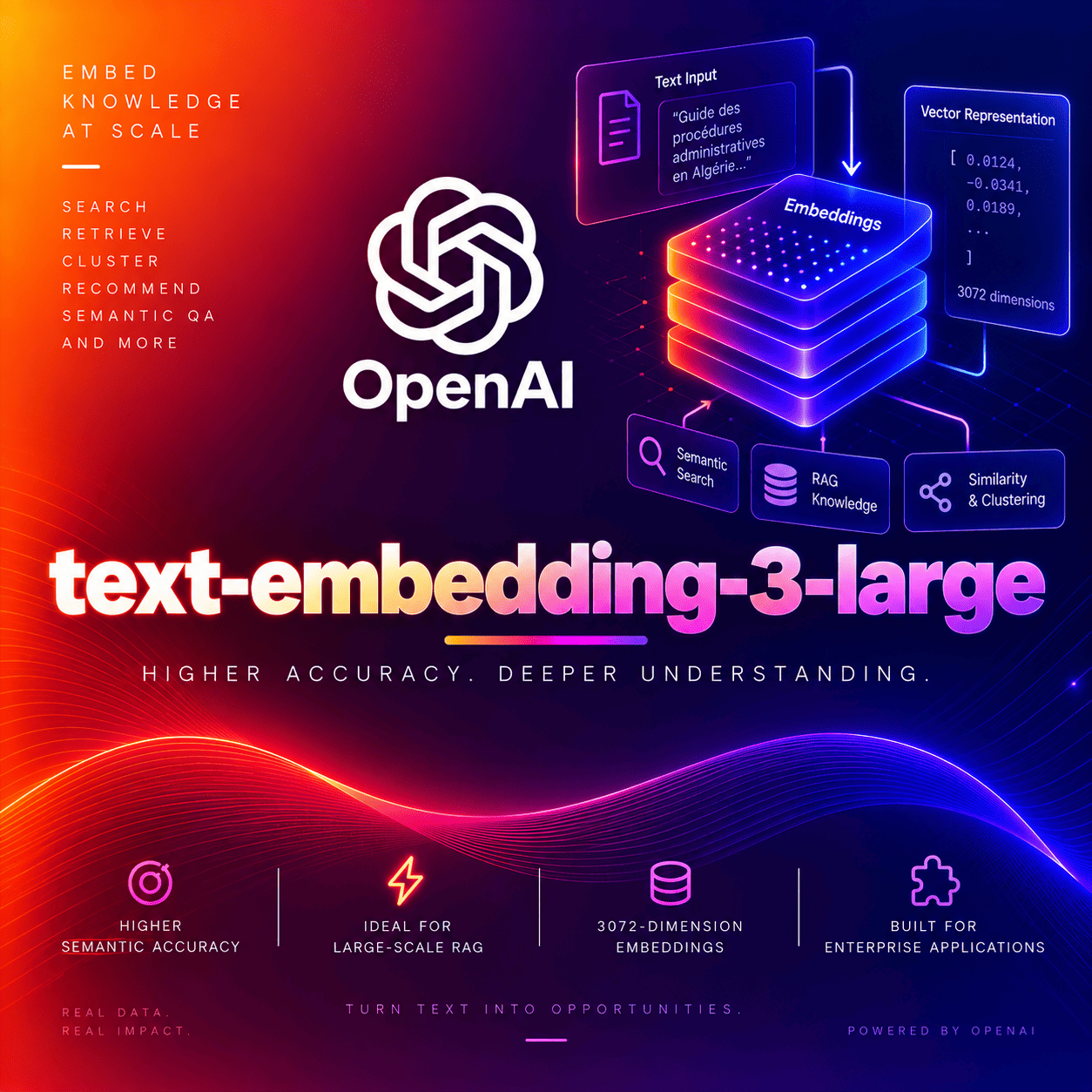
Text Embedding 3 Large is the higher-quality tier of OpenAI's current embedding generation, producing vectors of up to 3,072 dimensions against the smaller model's 1,536. The extra capacity shows most clearly on multilingual retrieval and on corpora where passages are semantically close and need to be told apart. Like its smaller sibling, the vector length is adjustable: a single parameter shortens the output without retraining, and shortening it is often the right call — a 1,536-dimension vector from this model generally retrieves better than a full-length vector from the smaller one, at identical storage cost. It handles inputs up to 8,191 tokens and produces deterministic, normalised output.
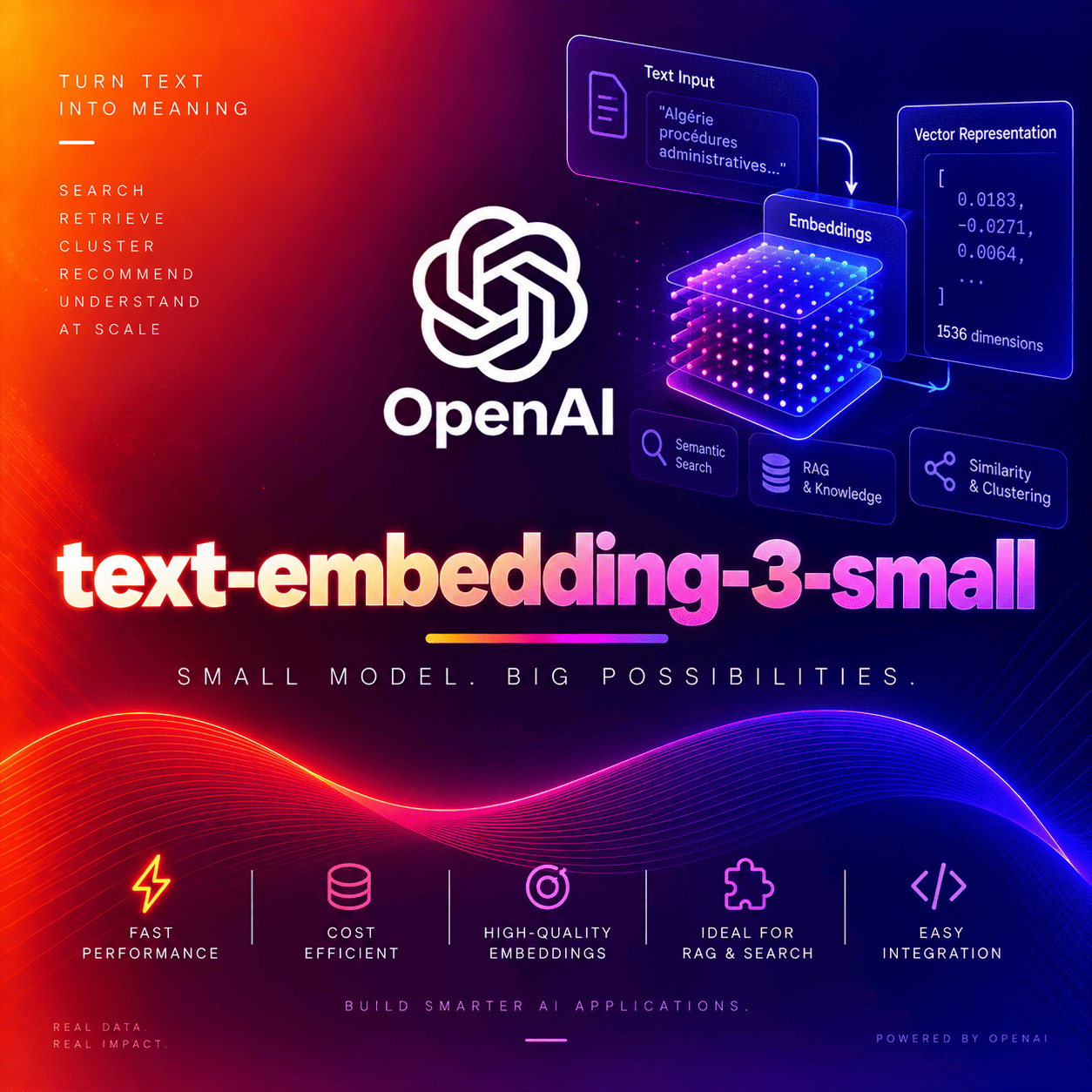
Text Embedding 3 Small converts text into numeric vectors for search, retrieval, clustering, and classification. Its defining feature is that the vector length is yours to choose: the full output runs to 1,536 dimensions, and a single parameter shortens it to anything smaller without retraining and without the quality collapse that naive truncation would cause. Cutting to 512 dimensions leaves most of the retrieval quality intact while reducing storage and comparison cost by two thirds — a trade that matters once an index holds millions of vectors rather than thousands. It handles inputs up to 8,191 tokens and returns deterministic output, so unchanged text always produces an identical vector.


all-mpnet-base-v2 is an open-source sentence embedding model developed by Sentence Transformers, built upon Microsoft's 109-million parameter MPNet (Masked and Permuted Pre-training) architecture. By combining the strengths of masked language modeling (BERT) and permuted language modeling (XLNet), it maps text into a dense 768-dimensional vector space. Fine-tuned on over 1 billion sentence pairs using contrastive learning, it long served as the primary quality gold standard among Sentence Transformers for semantic similarity, classification, and retrieval tasks.

all-MiniLM-L6-v2 is an ultra-lightweight, high-speed sentence embedding model developed by Sentence Transformers. Built on the 22.7-million parameter nreimers/MiniLM-L6-H384-uncased architecture (a 6-layer distilled version of BERT), it maps text into a compact 384-dimensional dense vector space. Trained on over 1 billion sentence pairs using self-supervised contrastive learning, it serves as the industry standard benchmark for edge deployments, in-browser inference, and real-time semantic search with minimal latency.

all-MiniLM-L12-v2 is a widely used, highly efficient sentence embedding model developed by Sentence Transformers. Based on the 33.4-million parameter microsoft/MiniLM-L12-H384-uncased architecture, it maps sentences and short paragraphs into a dense 384-dimensional vector space. Fine-tuned on over 1 billion sentence pairs using self-supervised contrastive learning, it offers an excellent balance between retrieval speed, memory footprint, and semantic accuracy, making it a foundational baseline for lightweight semantic search and clustering applications.


multilingual-e5-large-instruct is an open-source, instruction-tuned multilingual text embedding model developed by Microsoft Research. Built upon the 568-million parameter XLM-RoBERTa-large architecture, it supports over 100 languages and maps text into a 1024-dimensional dense vector space. Unlike previous E5 models that relied on rigid static prefixes, this model utilizes flexible, task-specific natural language instructions for queries while keeping target documents prefix-free, delivering superior custom retrieval accuracy and cross-lingual performance for global enterprise RAG systems.

multilingual-e5-large is an open-source, multilingual text embedding model developed by Microsoft Research. Built upon the 568-million parameter XLM-RoBERTa-large architecture, it supports over 100 languages and maps text into a 1024-dimensional dense vector space. Utilizing weakly-supervised contrastive pre-training and asymmetric prefix conditioning ("query: " and "passage: "), it delivers state-of-the-art cross-lingual retrieval and semantic search capabilities, making it a foundational model for global Retrieval-Augmented Generation (RAG) pipelines.

e5-large-v2 is an open-source text embedding model developed by Microsoft Research. Based on a 335-million parameter BERT-large encoder architecture, it maps text into a dense 1024-dimensional vector space using weakly-supervised contrastive pre-training followed by supervised fine-tuning. It utilizes asymmetric prefix conditioning ("query: " and "passage: ") to optimize dense retrieval and semantic search, delivering strong zero-shot retrieval accuracy across diverse domains with predictable inference latency.

e5-base-v2 is an open-source text embedding model developed by Microsoft Research. Based on a 109-million parameter BERT architecture, it is pre-trained using weakly-supervised contrastive learning. It generates 768-dimensional dense vectors and requires specific text prefixes ("query: " and "passage: ") to distinguish between search intents and document indexing, offering a strong balance between high retrieval accuracy and minimal computational cost for semantic search and RAG applications.


bge-m3-multi is an alternative designation for the bge-m3 embedding model developed by the Beijing Academy of Artificial Intelligence (BAAI). Built on a 567-million parameter XLM-RoBERTa architecture, the "Multi" suffix emphasizes its core design pillars: Multi-Linguality (supporting over 100 languages), Multi-Functionality (simultaneous Dense, Sparse, and Multi-Vector ColBERT outputs), and Multi-Granularity (handling inputs up to 512 tokens). It serves as a unified, state-of-the-art engine for hybrid search and complex multilingual Retrieval-Augmented Generation (RAG) pipelines.

bge-m3 is a state-of-the-art multi-lingual, multi-functionality, and multi-granularity text embedding model developed by the Beijing Academy of Artificial Intelligence (BAAI). Built on a 567-million parameter XLM-RoBERTa architecture, it supports over 100 languages and processes input sequences up to 8,192 tokens. It is uniquely engineered to output dense embeddings, lexical/sparse weights (similar to SPLADE), and multi-vector representations (ColBERT-style) simultaneously within a single forward pass, making it a foundational engine for versatile hybrid search and RAG systems.

bge-large-en-v1.5 is a high-performance open-source text embedding model developed by the Beijing Academy of Artificial Intelligence (BAAI). Built on a 335-million parameter BERT-large encoder architecture, it maps text into a dense 1024-dimensional vector space optimized for semantic search, retrieval-augmented generation (RAG), and zero-shot ranking. Version 1.5 improves similarity score distribution and delivers top-tier performance across the Massive Text Embedding Benchmark (MTEB) while balancing embedding accuracy with practical inference latency.

bge-en-icl is a 7.11 billion parameter large language model-based embedding model developed by the Beijing Academy of Artificial Intelligence (BAAI), built upon the Mistral-7B backbone. It introduces powerful in-context learning (ICL) capabilities to text embedding generation, allowing users to provide task-specific examples (few-shot prompts) alongside their queries. This eliminates the need for fine-tuning for new tasks while achieving state-of-the-art retrieval and semantic representation performance on benchmarks like MTEB and AIR-Bench.

bge-base-en-v1.5 is an open-source text embedding model developed by the Beijing Academy of Artificial Intelligence (BAAI). Built upon a 109-million parameter BERT-base encoder architecture, it maps text into a dense 768-dimensional vector space optimized for semantic search, dense retrieval, and Retrieval-Augmented Generation (RAG) pipelines. Version 1.5 refines similarity score distributions and delivers top-tier performance on the Massive Text Embedding Benchmark (MTEB) while maintaining extremely low latency and hardware requirements.
Nemotron-3-Embed-8B is a multilingual text embedding model from NVIDIA, based on Ministral-3-8B, that maps text into 4096-dimensional dense vectors for retrieval and semantic similarity. Spanning 34 languages, it targets multilingual RAG and question-answering over large corpora and achieves state-of-the-art results on the RTEB leaderboard.
Nemotron-3-Embed-1B-NVFP4 is the NVFP4-quantized version of Nemotron-3-Embed-1B-BF16 — a multilingual text embedding model from NVIDIA that maps text into 2048-dimensional dense vectors for retrieval and semantic similarity. Optimized for NVIDIA Blackwell GPUs (e.g. RTX 6000 PRO, GB200), it retains near-BF16 quality (RTEB 72.0 vs 72.4) at a fraction of the memory and compute.
Nemotron-3-Embed-1B-BF16 is a compact multilingual text embedding model from NVIDIA, pruned and distilled from Ministral-3 to ~1B parameters, that maps text into 2048-dimensional dense vectors for retrieval and semantic similarity. Spanning 34 languages, it delivers state-of-the-art quality among similarly sized models for RAG and multilingual question-answering while keeping compute cost low.

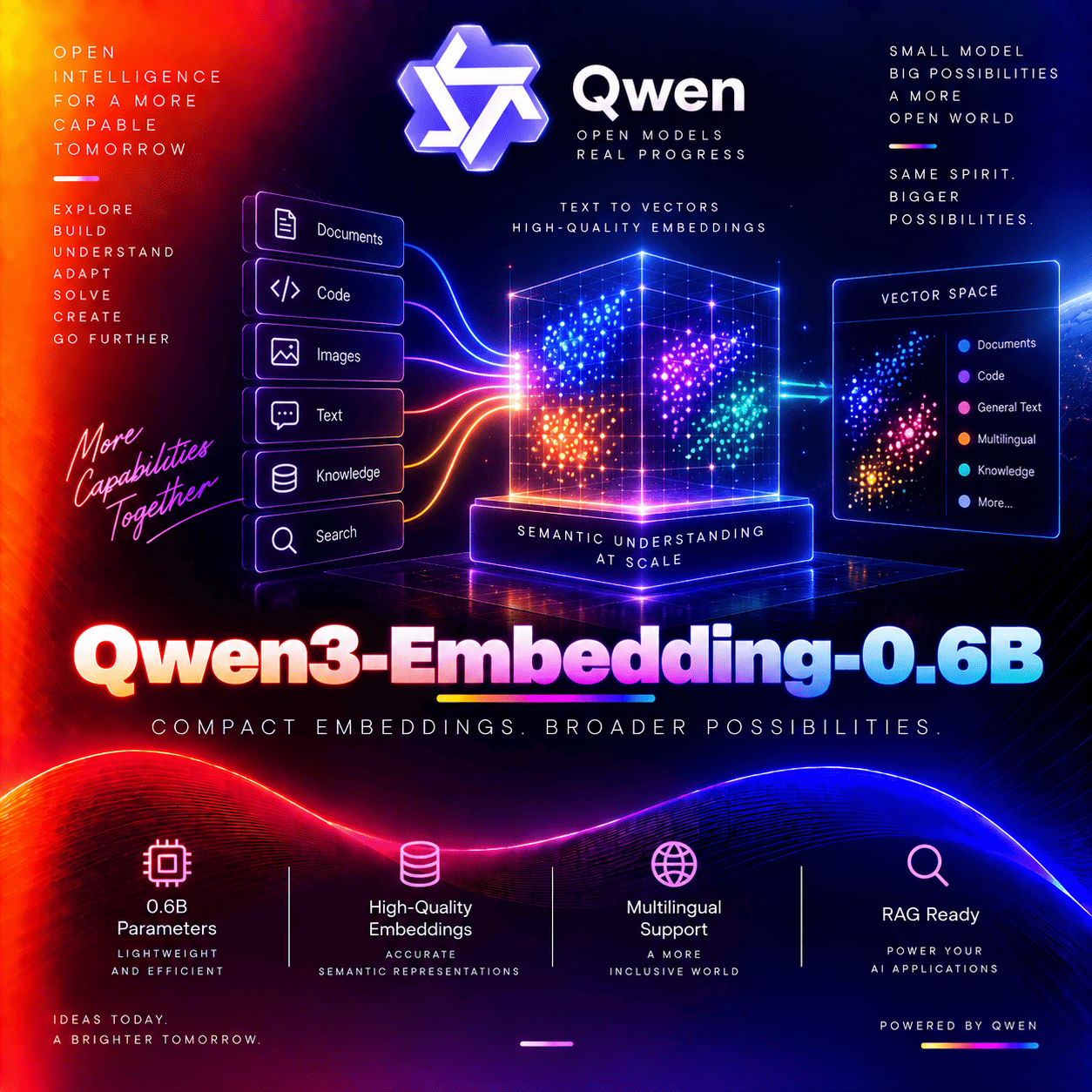
Qwen3-Embedding-0.6B is the entry point to a family where the entry point is not a compromise. It produces 1,024-dimension vectors from inputs as long as 32,768 tokens — the same window as the models four and thirteen times its size, which means it embeds whole documents rather than fragments. It supports Matryoshka truncation to shorten vectors without retraining, and task-specific instructions that Qwen measure as worth one to five percent. Six hundred million parameters puts it on modest hardware at high volume, which is exactly the shape embedding work takes: every document, once, then every query, forever.
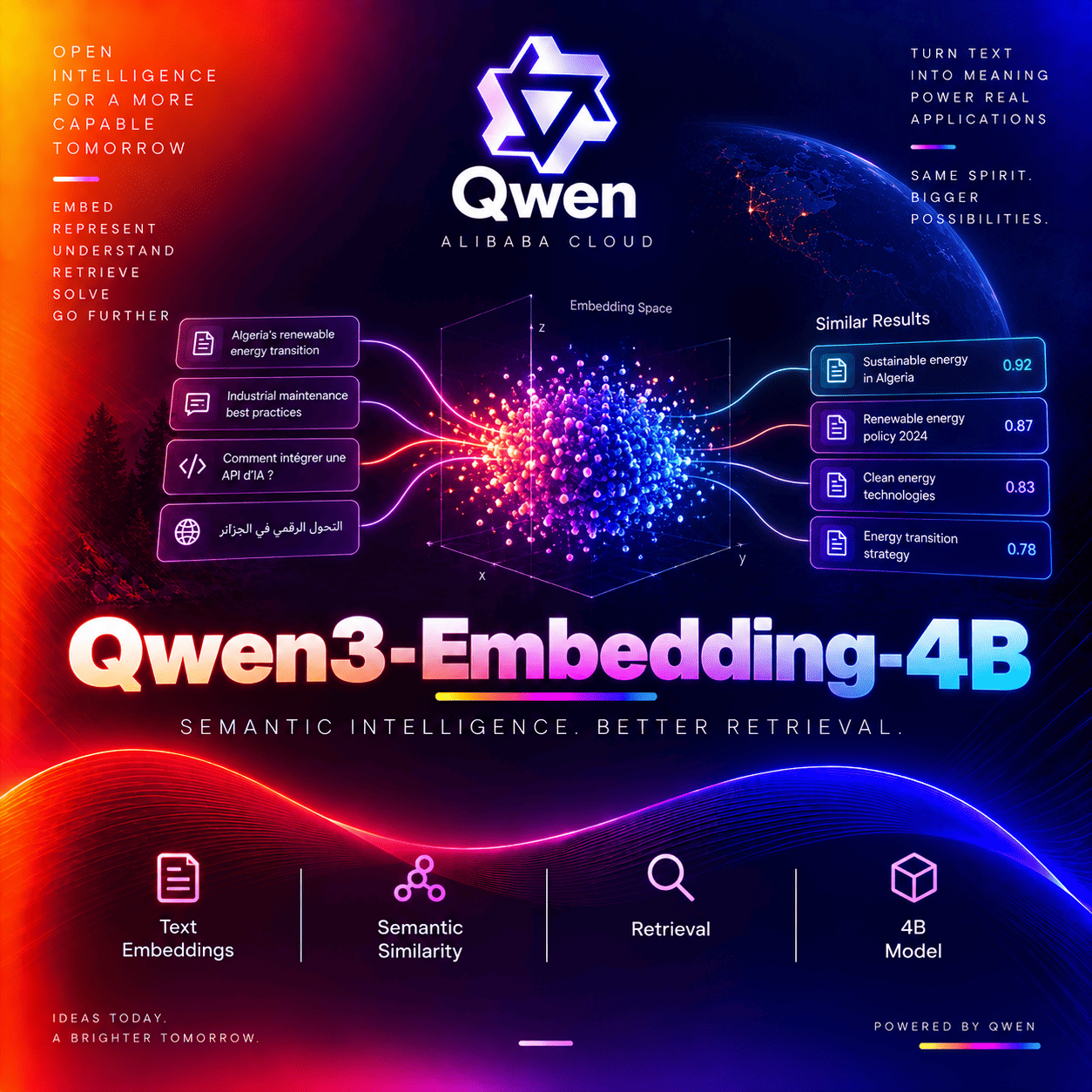
Qwen3-Embedding-4B produces vectors up to 2,560 dimensions from inputs as long as 32,768 tokens — a window most embedding models do not approach, and one that lets you embed a whole document rather than a fragment of one. It supports two forms of customisation that rarely appear together: Matryoshka representation learning, so the vector can be truncated to a smaller size without retraining, and task-specific instructions, which Qwen measure as worth one to five percent on most downstream work. Over a hundred languages, including programming languages, under Apache 2.0.
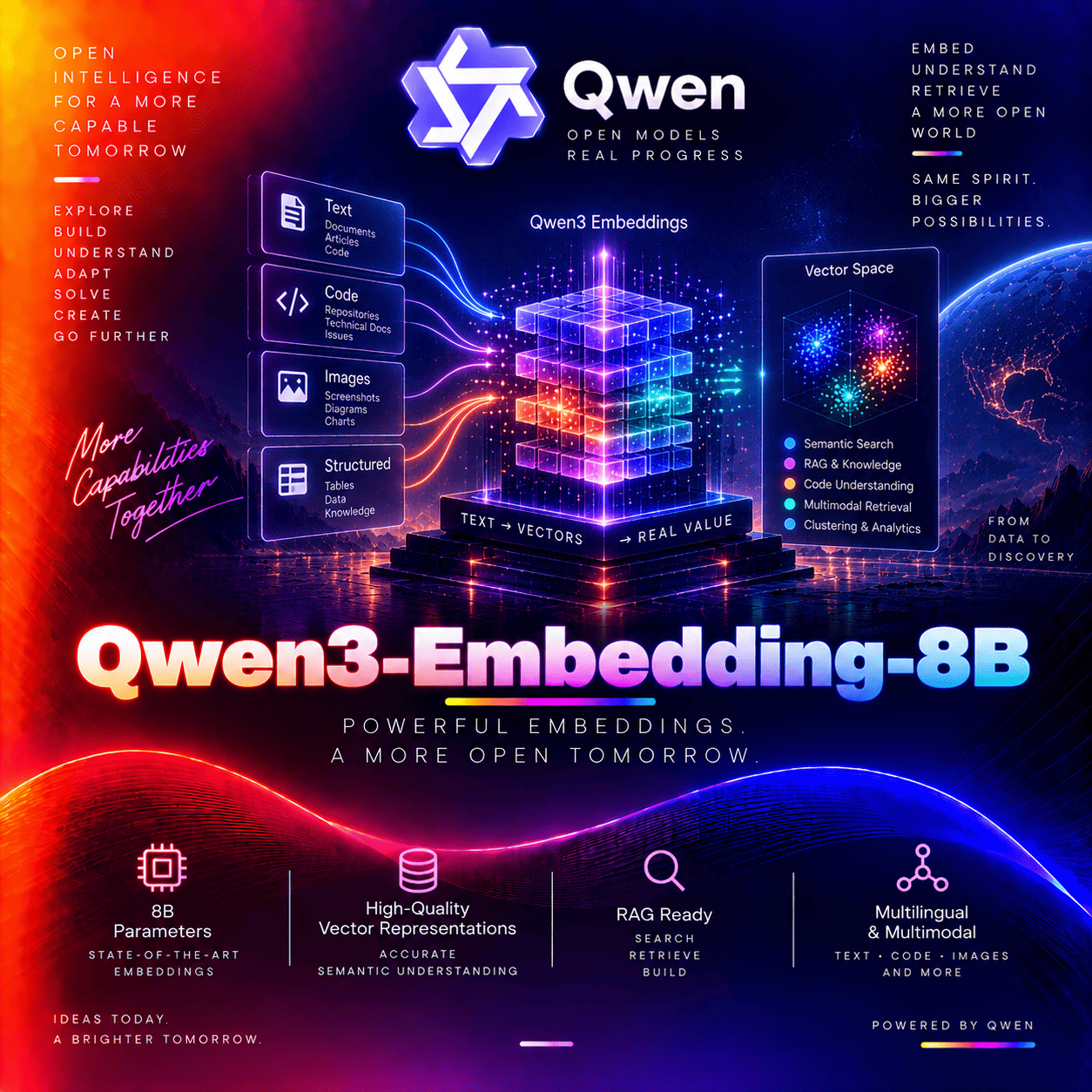
Qwen3-Embedding-8B took first place on the MTEB multilingual leaderboard at release, scoring 70.58 in June 2025. It produces vectors anywhere from 32 to 4,096 dimensions — a continuous range rather than a menu — from inputs as long as 32,768 tokens, across more than a hundred human and programming languages. Task-specific instructions are supported and measured as worth one to five percent. Its final training stage is unusual: rather than producing a single model, several candidates were merged, balancing generalisation against task adaptability. Apache 2.0.

The llama-nemotron-embed-vl-1b-v2 is a high-performance multimodal embedding model designed to transform text queries and document images into dense vector representations for advanced retrieval systems. It excels at understanding complex visual content like charts, tables, and infographics.
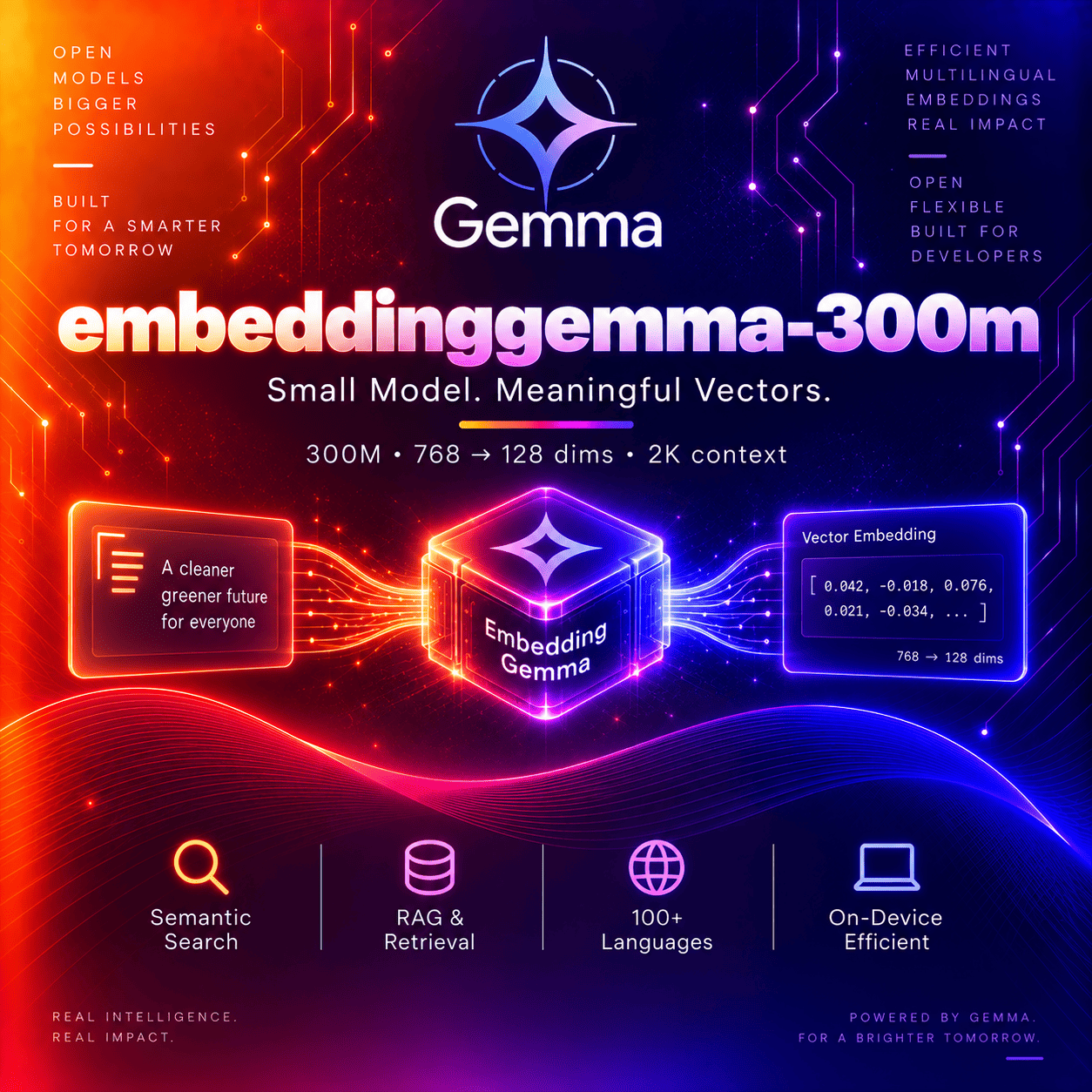
EmbeddingGemma turns text into vectors at 300 million parameters — small enough to run on a phone, and the highest-ranking open multilingual embedding model under 500M on MTEB. It was trained with Matryoshka Representation Learning, so the 768-dimensional output can be truncated to 512, 256, or 128 and re-normalised, with the cost of each step published rather than estimated: half the storage costs 0.44 points on multilingual retrieval. Built from Gemma 3 on 320 billion tokens across more than a hundred languages, it handles inputs up to 2,048 tokens and produces deterministic output.


