Model Library
Browse and deploy state-of-the-art AI models through the DEVUP Gateway.
Loading models...
Model Library
Browse and deploy state-of-the-art AI models through the DEVUP Gateway.
Browse and deploy state-of-the-art AI models through the DEVUP Gateway.

GPT-6 Astra is OpenAI's most capable model and the one its documentation recommends by default: built for the hardest end-to-end work rather than for any single task. It carries the newest knowledge of anything in OpenAI's catalogue, against a context window slightly beyond a million tokens and a 128,000-token output ceiling. Reasoning runs across four effort levels — and unlike the generation below it, deliberation cannot be switched off, which is a deliberate signal about what this model is for. It accepts text and images, calls functions, and returns structured output. On DEVUP AI it is reachable through the standard OpenAI-compatible endpoint, billed in Algerian Dinar.

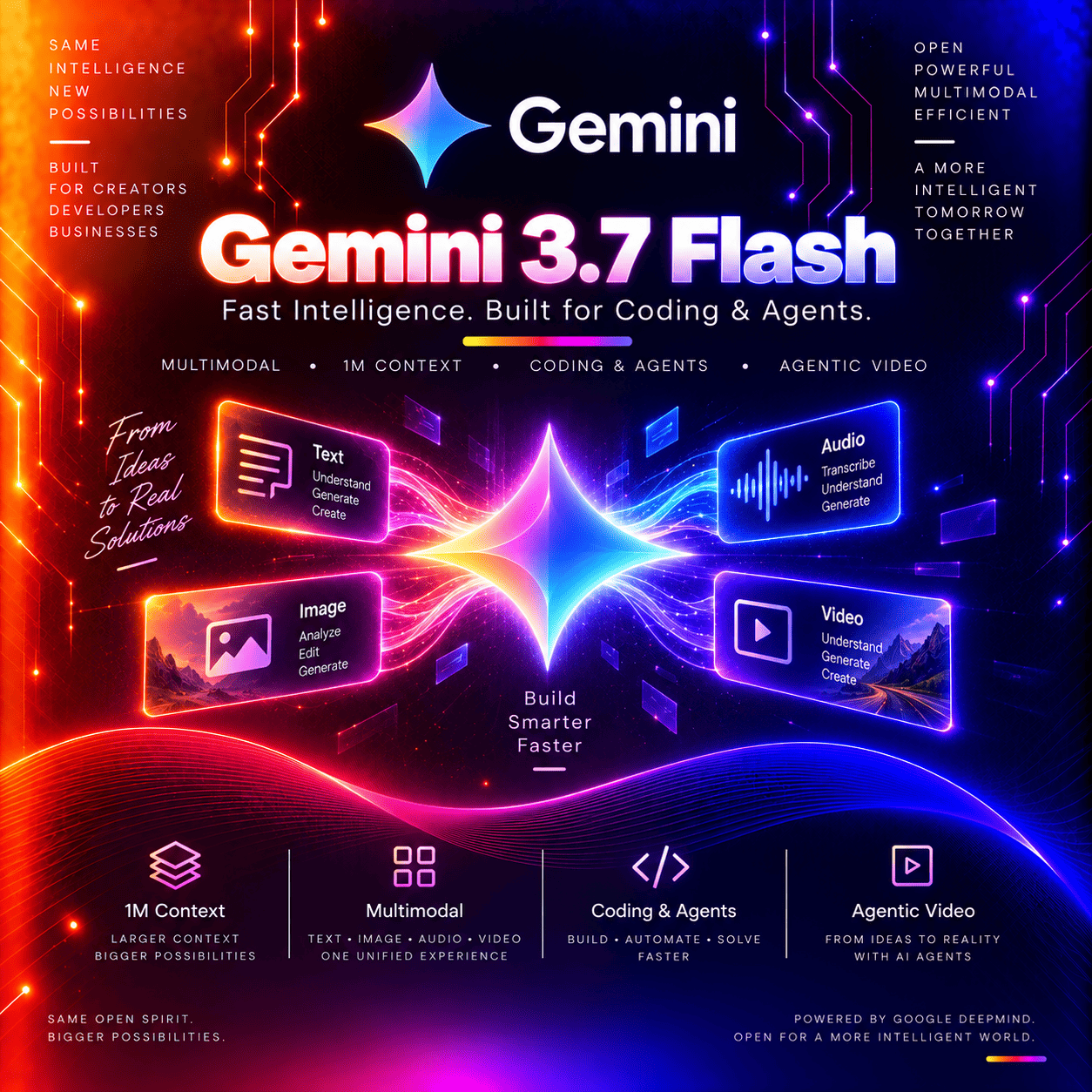
Gemini 3.7 Flash is Google's most capable Flash-tier model, built for coding and agentic work rather than for chat alone. It is natively multimodal in the widest sense available: text, images, video, audio, and PDFs all go in directly, against a one-million-token context window, with no separate extraction step in front of it. Thinking depth is a request-level setting with three levels, letting the same model serve a latency-critical pipeline and a long multi-step agent run. Google reports large gains over the previous Flash generation on issue resolution, production-ready code generation, complex document processing, and real-world business automation. On DEVUP AI it is the natural choice when your input is not plain text and your workflow has more than one step.

DeepSeek-V4.1-Flash-1017 is a multimodal reasoning model built for coding, agentic workflows, and visual understanding. This update improves published benchmark results over V4.1-Flash while reducing task completion time and output length in reported evaluations.

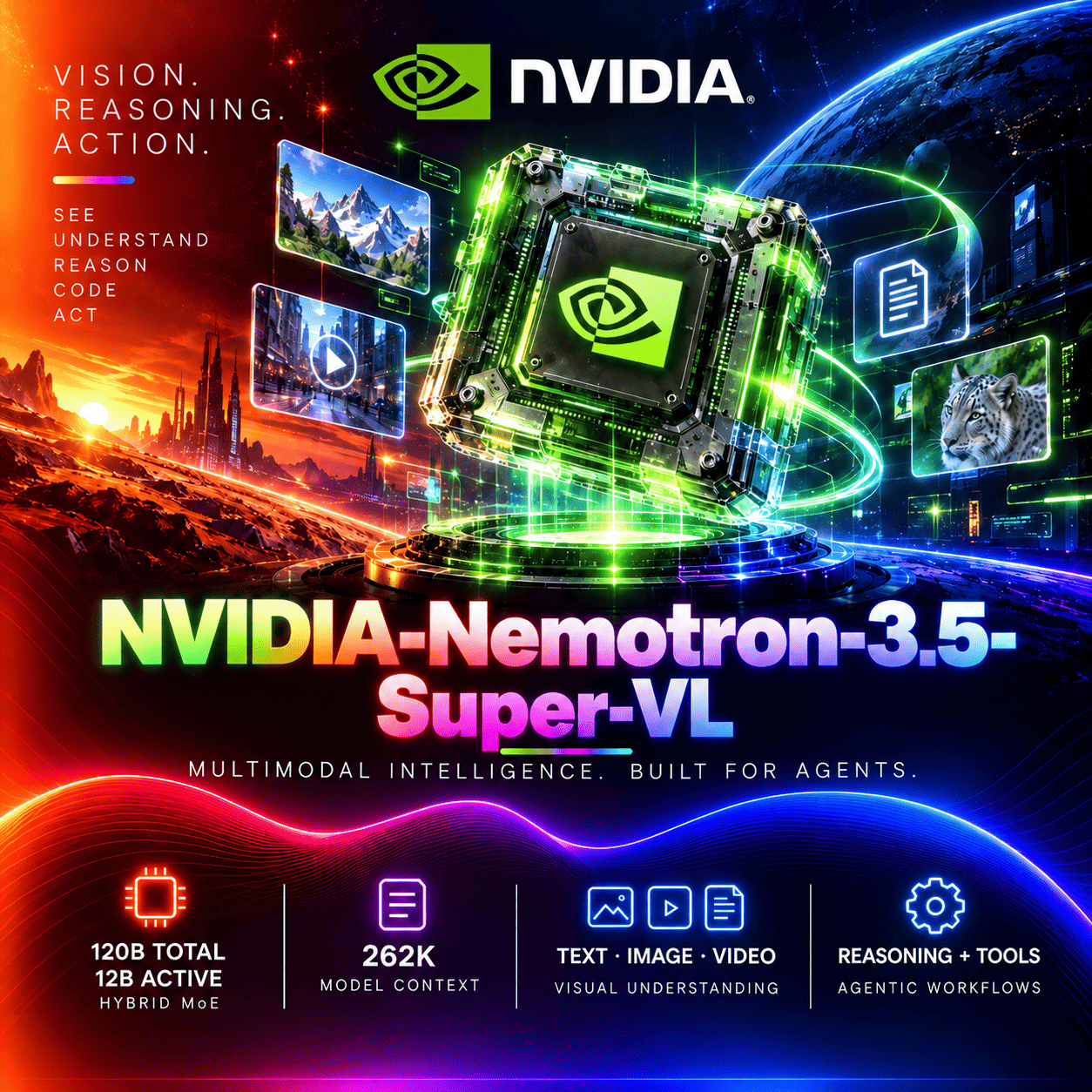
NVIDIA Nemotron 3.5 Super VL is an open multimodal model for agents that see, reason, and act. Its 120-billion-parameter hybrid design activates 12 billion per token, interleaving Mamba-2, attention, and mixture-of-experts layers with a C-RADIO vision encoder, and it reads text, images, document pages, interfaces, and video clips of up to two minutes. Reasoning can run in full, at medium effort, or not at all. Its language backbone was distilled from NVIDIA's largest Nemotron model over a trillion tokens, then trained on repositories, pull requests, and build logs, and it reports one of the lowest hallucination rates in its own comparison. Released openly under OpenMDW-1.1.

Claude Opus 5.5 is the first model in its family where the default reasoning effort went down rather than up — from high on the previous generation to medium here — because it reaches the same conclusions with fewer tokens. Customers evaluating it report its lowest effort setting matching or beating the previous model's highest. Thinking is adaptive and always on, across a one-million-token window with 128,000 tokens of output, and it reads images as well as text. Anthropic publish its benchmark results with production safeguards enabled, noting that this likely lowers the scores.
GPT-6 Luna is the tier OpenAI describe as handling clerical work — summarising, extracting, answering — and it carries the same 1.05-million-token window, the same reasoning range from none through max, and the same caching improvements as the model above it. Two things distinguish it. Its knowledge cutoff is more recent than the more expensive tier's, which inverts the usual assumption. And its output-token reduction over its predecessor exceeded the fifty percent headline, which matters most on exactly the high-volume work it was built for.
GPT-6 Sol brings the training methods of OpenAI's flagship to a tier meant to be used far more often. Its most consequential change is not in the model but around it: reasoning effort and tool availability can now be altered mid-conversation without invalidating the prompt cache, which makes starting cheap and escalating only on the hard step a workable pattern rather than a costly one. Reasoning runs from none through max, the context window holds 1.05 million tokens with 922,000 available for input, and OpenAI report roughly half the factual errors of its predecessor alongside lower rates of agents claiming work they did not do.

Ling-3.0-flash-VL adds image and video understanding to Ling-3.0-flash, and the interesting part is that vision did not sit alongside the language model — it raised it. On the Artificial Analysis intelligence index the visual model scores 42 against 38 for the text model it was built from, on the same 124-billion-parameter foundation with only 5.5 billion active per inference step. A vision encoder feeds a two-layer projector that aligns visual features with text, while a space-and-time positional encoding handles video. What it was built to do is act on what it sees: read a design reference and write the interface, render the result and compare it against the original, identify elements on a screen and operate them.
DeepSeek V4 Flash Vision Exp is an experimental vision-enabled build of V4 Flash, and it takes an unusual approach to image cost: every image is capped at 384 tokens regardless of its resolution. A two-megapixel scan and a twenty-five-megapixel one bill identically, because both are resized to the same working size before inference. That turns document processing from an open-ended cost into arithmetic you can do before sending the request. It accepts up to six hundred images per call, matches the text model it is built on across agents, reasoning, and world knowledge, and holds the same million-token context. On DEVUP AI it is the choice when the workload is pages rather than paragraphs.
Claude Opus 5 is Anthropic's model for complex agentic coding and enterprise work, and it thinks by default. Adaptive thinking means the model decides when and how much to reason on each turn rather than waiting to be told, with effort selectable across five levels. Its million-token context window is both the default and the maximum — there is no smaller variant and no long-context surcharge — and instruction following, tool calling, and reasoning stay consistent across the full window. The largest gains over the previous generation are in sustained multi-step analysis, long-horizon agentic work that completes features rather than leaving stubs, and converting additional effort into measurably better results.
Claude Fable 5 was Anthropic's most capable widely released model, built for demanding reasoning and long-horizon agentic work. Two things set it apart from everything else in this catalogue. Thinking is permanently on — there is no parameter that disables it, only an effort dial that sets how deep it goes. And it ships with safety classifiers that can decline a request, returning a successful response carrying a refusal rather than an error, which means any integration must inspect why a response ended rather than assuming a 200 means an answer. It holds a million-token context with a 128,000-token output ceiling, and reads text and images.
Claude Sonnet 5 pairs a million-token context window with the fastest comparative latency in its generation, which is what makes it the working default rather than an economy option. It matches the Opus tier on window size and output ceiling while answering noticeably quicker, and adaptive thinking is on by default with five effort levels controlling how deep it goes. One integration detail separates it from most models in this catalogue: sampling parameters are rejected outright. Send a temperature, a top-p, or a top-k at anything other than its default and the request returns an error rather than quietly ignoring it — so output variation is shaped through effort and prompting instead.
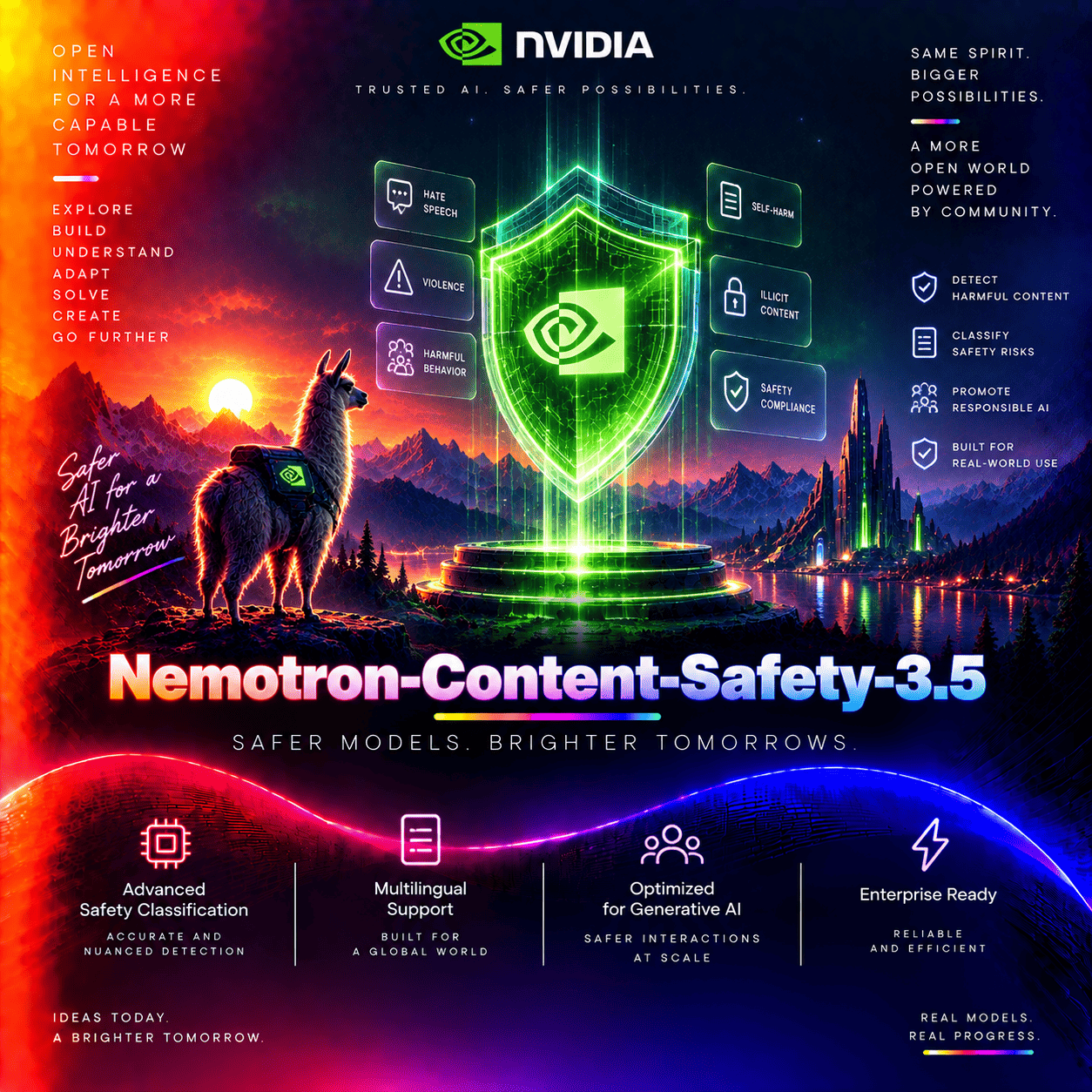
Nemotron 3.5 Content Safety is a four-billion-parameter moderator that can explain itself. It classifies a prompt, an optional image, and an optional response across a twenty-three-category taxonomy — and in think mode it emits an auditable reasoning trace before the verdict, which is what makes a blocked decision defensible rather than merely enforced. It also accepts your own safety policy in place of the default taxonomy. Its twelve languages were not translated but culturally adapted, addressing a measured problem: models produce more unsafe content in non-English languages because safety training data lacks cultural nuance. It runs on a single L4.
Bring any idea to life with state-of-the-art reasoning to help you learn, build, and plan anything. Best for complex tasks and bringing creative concepts to life.
Gemini 3.5 Flash delivers near-Pro intelligence at Flash-tier cost and speed: Pro-level coding proficiency, parallel agentic execution, all at a much lower price.
Bring any idea to life with state-of-the-art reasoning to help you learn, build, and plan anything. Best for high-volume tasks that need efficiency and intelligence.

Gemma 3 4B fits in 2.6 gigabytes at int4 and carries the same vision encoder as the 27-billion-parameter model at the top of its family — frozen and shared across sizes, so perception does not shrink with the model. It reads text and images across a 128K context window on hardware where that combination is normally impossible: a phone, a single-board computer, an integrated GPU. Google describe it as competitive with the previous generation's 27B flagship. What it costs you is measurable and concentrated in hard reasoning, where the gap to the larger siblings is real.
Gemma 3 27B was built to be the most capable model you can run on one GPU, and the quantisation numbers make that literal: 54 GB at bfloat16 drops to 14.1 GB at int4, which fits a desktop RTX 3090. The saving comes from quantisation-aware training rather than a conversion applied afterwards, so quality stays close to full precision. Its 128K context rests on a 5:1 ratio of local to global attention layers — a design Google measured as cutting KV-cache overhead from sixty percent to under fifteen. It reads text and images across 140 languages, with an 8,192-token output ceiling.
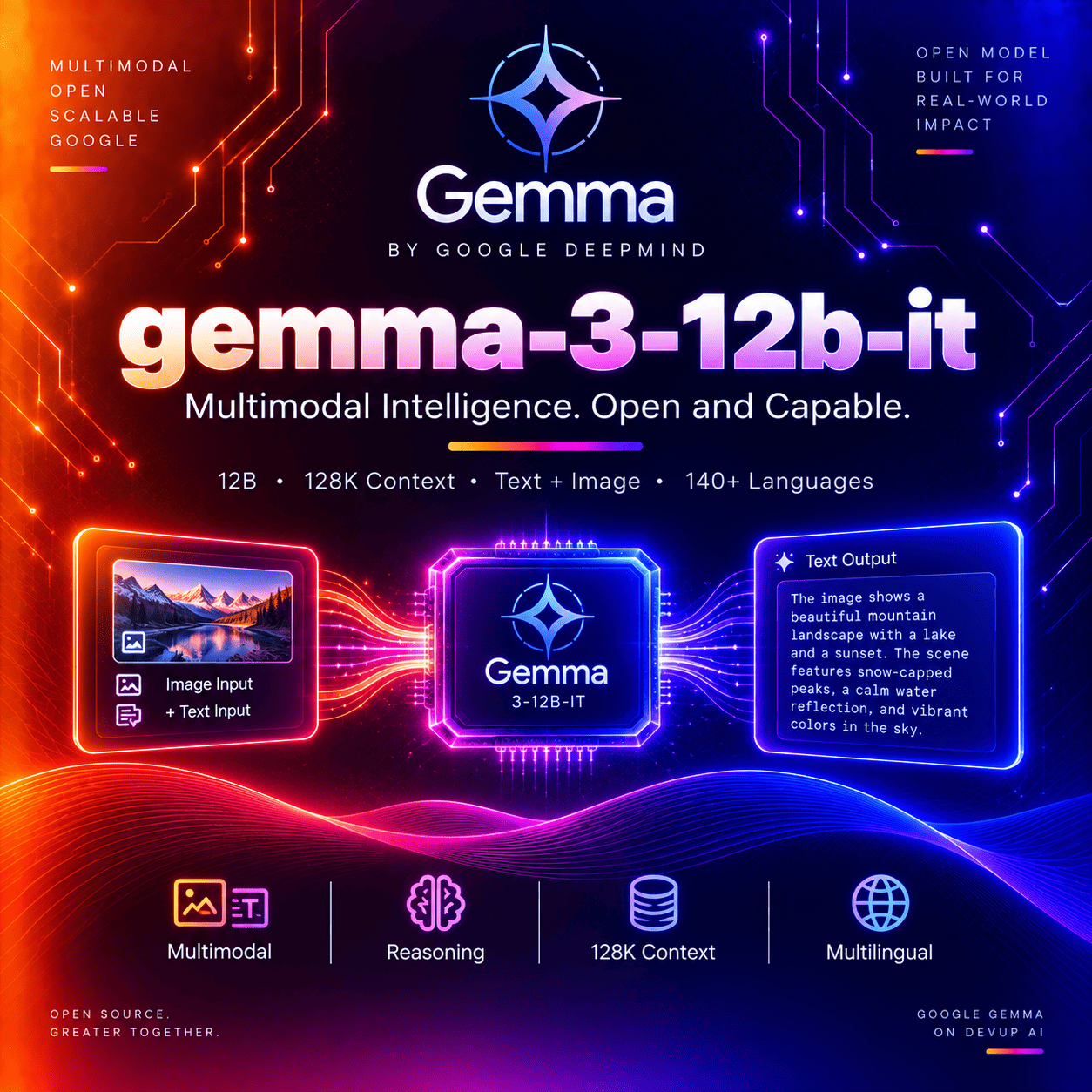
Gemma 3 12B reads images the way a person does when the print is small: it looks at the whole thing, then looks closer at the parts. Its vision encoder compresses every image into exactly 256 tokens at 896×896 — efficient, and destructive on a wide screenshot or a tall document. Pan & Scan solves that at inference time by cutting the image into non-overlapping crops and processing each separately, worth a measured 8 to 17 percent on tasks that require reading text from images. The 128K context comes from interleaving five local attention layers per global one, so only one layer in six carries a large cache, at a perplexity cost under five percent.

Qwen3-VL-30B-A3B-Instruct runs the same vision stack as the flagship of its series on roughly three billion active parameters. DeepStack, interleaved multi-axis positional encoding, timestamp-grounded event localisation, and OCR across 32 languages — all present, none reduced. What scales down is the language reasoning over what it sees, not the seeing itself. That combination is unusual and it decides the workload: document archives, receipt pipelines, video indexing at volume, where per-page cost determines whether the corpus gets processed at all rather than how well.
Qwen3-VL-235B-A22B-Instruct is the vision-language flagship of its series, and three named mechanisms explain what it does differently. DeepStack fuses features from multiple levels of the vision encoder rather than reading only its final layer, which is where fine detail survives. Interleaved-MRoPE allocates positional frequency across time, width, and height together for long-horizon video. And text–timestamp alignment grounds events to the second rather than to the clip. Its OCR covers 32 languages and is built for low light, blur, and tilt — real photographs rather than clean scans. It answers directly, with no reasoning blocks.

Mistral Small 3.2 is a minor update that fixes three specific things, and the most valuable of them is measured: infinite generations — where a model repeats itself until it hits the token ceiling — were halved on long, repetitive prompts. Instruction following tightened, and the function-calling template was rebuilt to be more robust. Everything else matches or slightly improves on the release before it. It reads text and images across a 128,000-token window, covers twenty-four languages, and ships under Apache 2.0 with a recommended temperature of 0.15 — unusually low, and directly connected to the repetition fix.
Claude Opus 4.8 answers directly unless asked to think — the opposite default from the generation that replaced it, and the reason some integrations still prefer it. A plain request returns text immediately, with no reasoning blocks ahead of the answer and no deliberation budget to account for. Adaptive thinking is available per request when a task needs it, and switching it off works at any effort level rather than only below a threshold. It carries a million-token context window with a 128,000-token output ceiling, reads text and images, and offers a fast mode that runs at roughly two and a half times normal speed through a research preview.

Llama Guard 4 is a safety classifier that happens to be a language model. Give it a prompt or a response — text, images, or both — and it answers in two lines: safe or unsafe, and if unsafe, which categories were violated. Nothing else. It was built by pruning Llama 4 Scout's mixture-of-experts architecture down to its shared expert alone, producing a dense twelve-billion-parameter model with no additional pre-training. It replaces two earlier models, one for text and one for vision, with a single classifier aligned to the MLCommons hazard taxonomy — and it runs on one 24 GB card.


