Model Library
Browse and deploy state-of-the-art AI models through the DEVUP Gateway.
Loading models...
Model Library
Browse and deploy state-of-the-art AI models through the DEVUP Gateway.
Browse and deploy state-of-the-art AI models through the DEVUP Gateway.

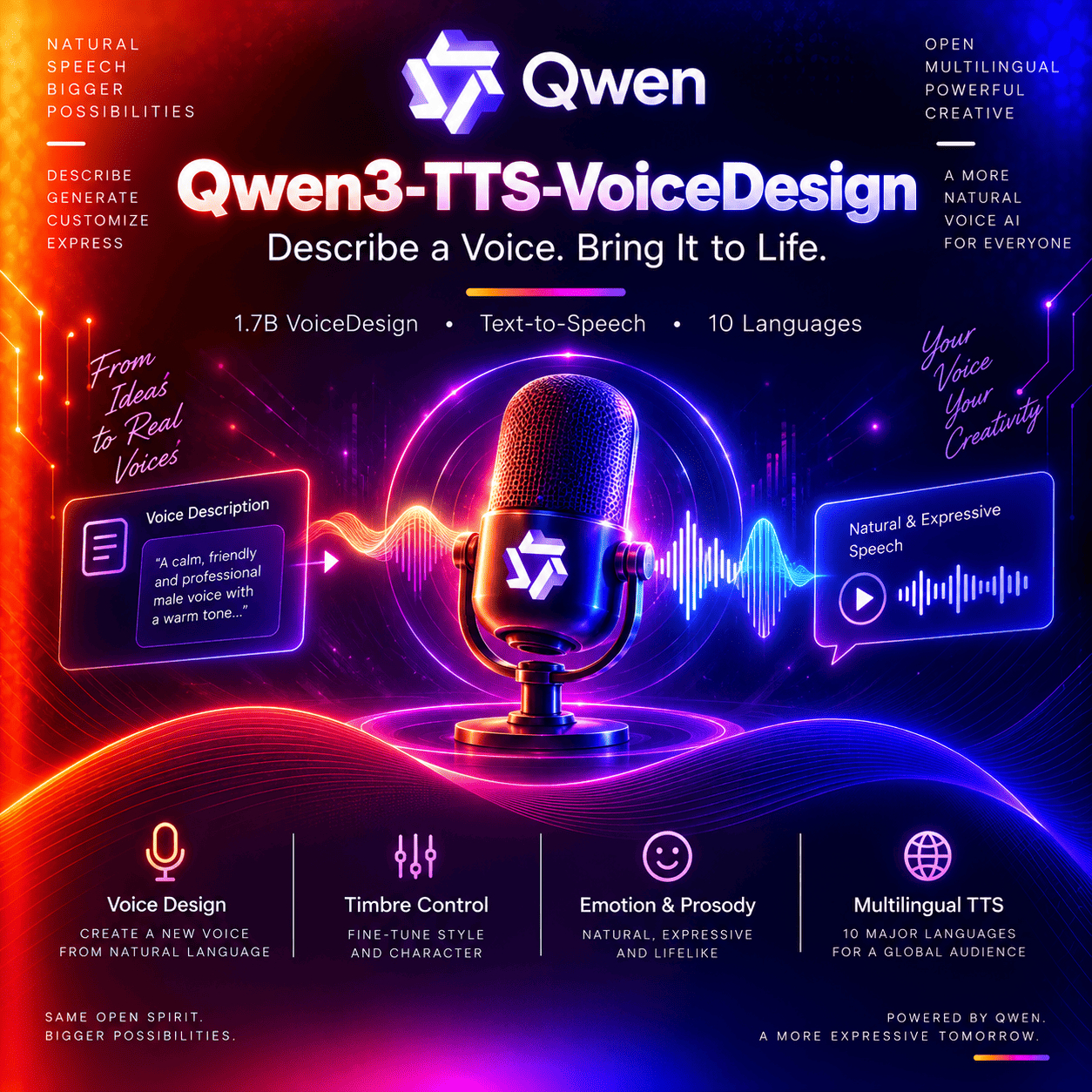
Qwen3-TTS-VoiceDesign invents a speaker rather than copying one. Describe a voice in plain language — age, timbre, accent, mood, pacing — and the model synthesises someone who sounds like that, with no reference recording involved. That is the opposite of voice cloning, and it makes the technique usable where no sample exists or where using a real person's voice is not an option. Qwen report it outperforming a leading closed-source voice-design model on instruction-following and expressiveness alike. It covers ten languages plus dialectal profiles, runs at 1.7 billion parameters, and ships under Apache 2.0.
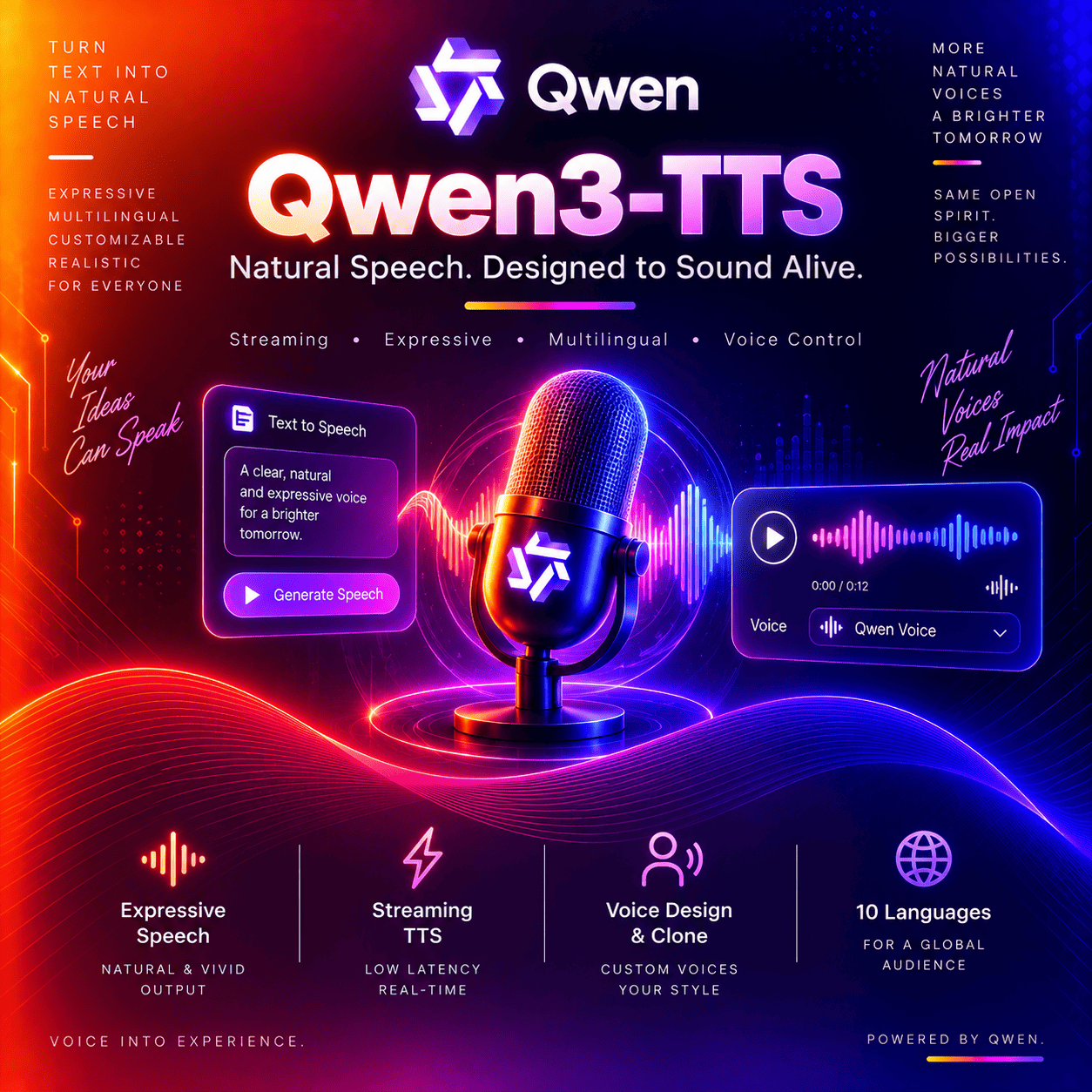
Qwen3-TTS is a family of open speech models built on a tokenizer Qwen developed themselves — a multi-codebook encoder running at 12 Hz that compresses speech while preserving the parts most systems discard: breath, hesitation, emphasis, and the acoustics of the room. It covers voice cloning from a sample, voice design from a description, style control at fixed timbre, and long-form synthesis. That last capability carries the most convincing number: ten minutes of continuous speech at a 2.36% word error rate in Chinese and 2.81% in English, where most systems drift. Ten languages, dialectal profiles, Apache 2.0.

A 0.6B-parameter multilingual text-to-speech model with zero-shot voice cloning, supporting 11 languages.

Realtime TTS 2.0 is a low-latency text-to-speech model with natural language steering, allowing you to control tone and emotion directly in the prompt (e.g., “[be happy and upbeat] Hello!”). It supports cross-lingual voices and multiple languages, enabling the same voice to speak consistently across different languages. This is an early access preview ahead of full launch, with ongoing improvements to voice quality and steering.
Fast multilingual text-to-speech model by Inworld AI with 130+ preset voices across 15 languages. Supports voice cloning, word-level timestamps, and streaming. Optimized for low-latency applications with <130ms time-to-first-audio.
High-quality multilingual text-to-speech model by Inworld AI with 130+ preset voices across 15 languages. Supports voice cloning, word-level timestamps, and streaming. Optimized for natural, expressive speech with <250ms time-to-first-audio.


Kokoro is an open-weight TTS model with 82 million parameters. Despite its lightweight architecture, it delivers comparable quality to larger models while being significantly faster and more cost-efficient. With Apache-licensed weights, Kokoro can be deployed anywhere from production environments to personal projects.

Orpheus TTS is a state-of-the-art, Llama-based Speech-LLM designed for high-quality, empathetic text-to-speech generation. This model has been finetuned to deliver human-level speech synthesis, achieving exceptional clarity, expressiveness, and real-time streaming performances.

HiggsAudioV2.5 is a high-quality neural text-to-speech (TTS) model designed for natural-sounding voice generation across a wide range of use cases. It focuses on clarity, stable prosody, and consistent pacing, making it suitable for both short prompts and longer narration.

09/04 🔥 Introducing Chatterbox Multilingual in 23 Languages! We're excited to introduce Chatterbox and Chatterbox Multilingual, Resemble AI's production-grade open source TTS models. Chatterbox Multilingual supports Arabic, Danish, German, Greek, English, Spanish, Finnish, French, Hebrew, Hindi, Italian, Japanese, Korean, Malay, Dutch, Norwegian, Polish, Portuguese, Russian, Swedish, Swahili, Turkish, Chinese out of the box. Licensed under MIT, Chatterbox has been benchmarked against leading closed-source systems like ElevenLabs, and is consistently preferred in side-by-side evaluations.
Chatterbox is a family of three state-of-the-art, open-source text-to-speech models by Resemble AI. We are excited to introduce Chatterbox-Turbo, our most efficient model yet. Built on a streamlined 350M parameter architecture, Turbo delivers high-quality speech with less compute and VRAM than our previous models. We have also distilled the speech-token-to-mel decoder, previously a bottleneck, reducing generation from 10 steps to just one, while retaining high-fidelity audio output. Paralinguistic tags are now native to the Turbo model, allowing you to use [cough], [laugh], [chuckle], and more to add distinct realism. While Turbo was built primarily for low-latency voice agents, it excels at narration and creative workflows. If you like the model but need to scale or tune it for higher accuracy, check out our competitively priced TTS service (link).
Automatically convert input text into natural and fluent speech output. You can generate natural and vivid speech content by configuring parameters such as speech style and voice. Use the high-quality voices from the built-in voices list.
Automatically convert input text into natural and fluent speech output. You can generate natural and vivid speech content by configuring parameters such as speech. Precisely replicate voices from audio samples to enable speech synthesis of any voice. style and voice.

Automatically convert input text into natural and fluent speech output. You can generate natural and vivid speech content by configuring parameters such as speech style and voice. Automatically generate voices from text descriptions, without requiring presets or audio samples.


