Model Library
Browse and deploy state-of-the-art AI models through the DEVUP Gateway.
Loading models...
Model Library
Browse and deploy state-of-the-art AI models through the DEVUP Gateway.
Browse and deploy state-of-the-art AI models through the DEVUP Gateway.

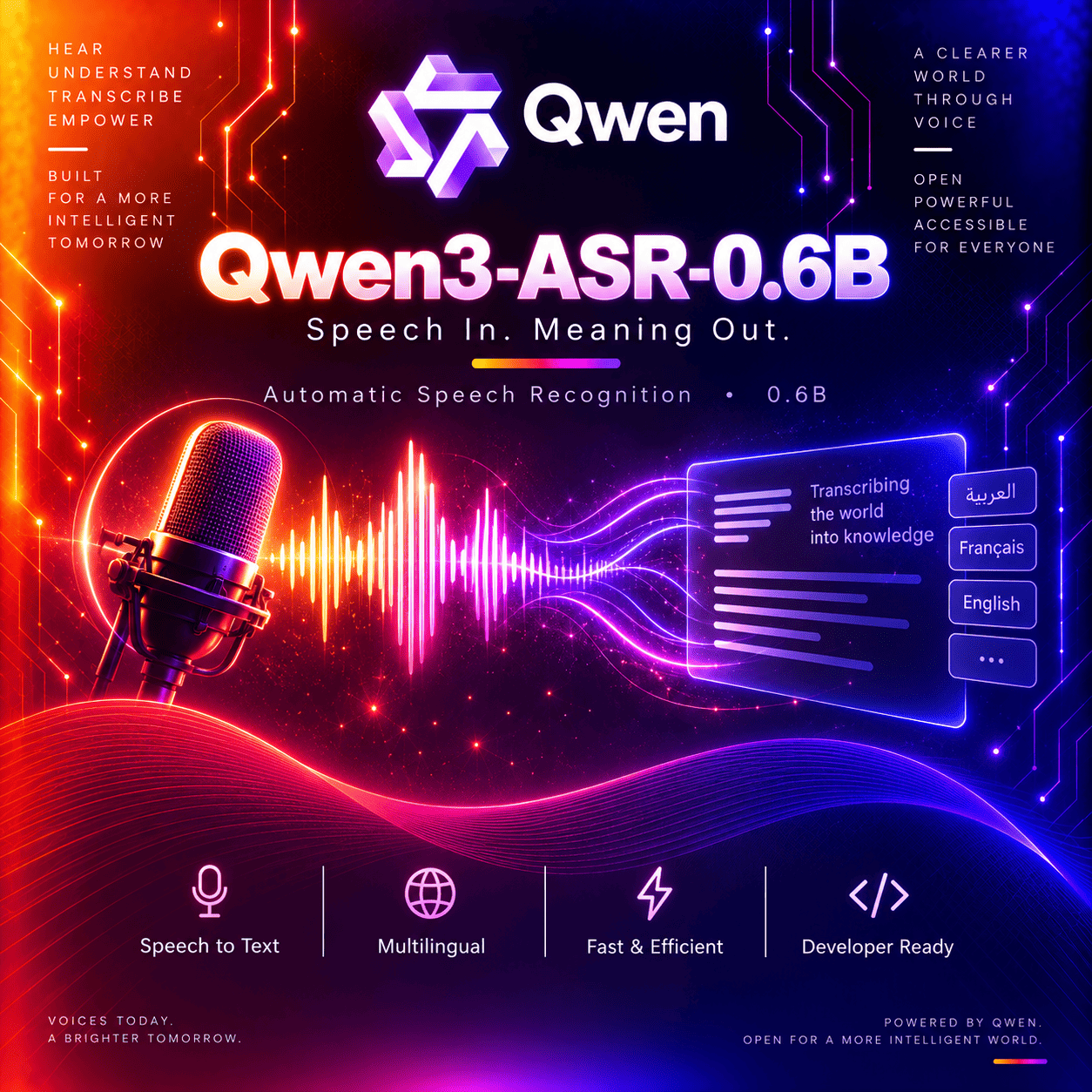
Qwen3-ASR-0.6B is the compact model of the Qwen3-ASR family: multilingual language identification and speech recognition across 30 languages and 22 Chinese dialects, built on Qwen3-Omni. It targets an accuracy-efficiency trade-off with very high throughput, unified streaming/offline inference, and segment- and word-level timestamps.
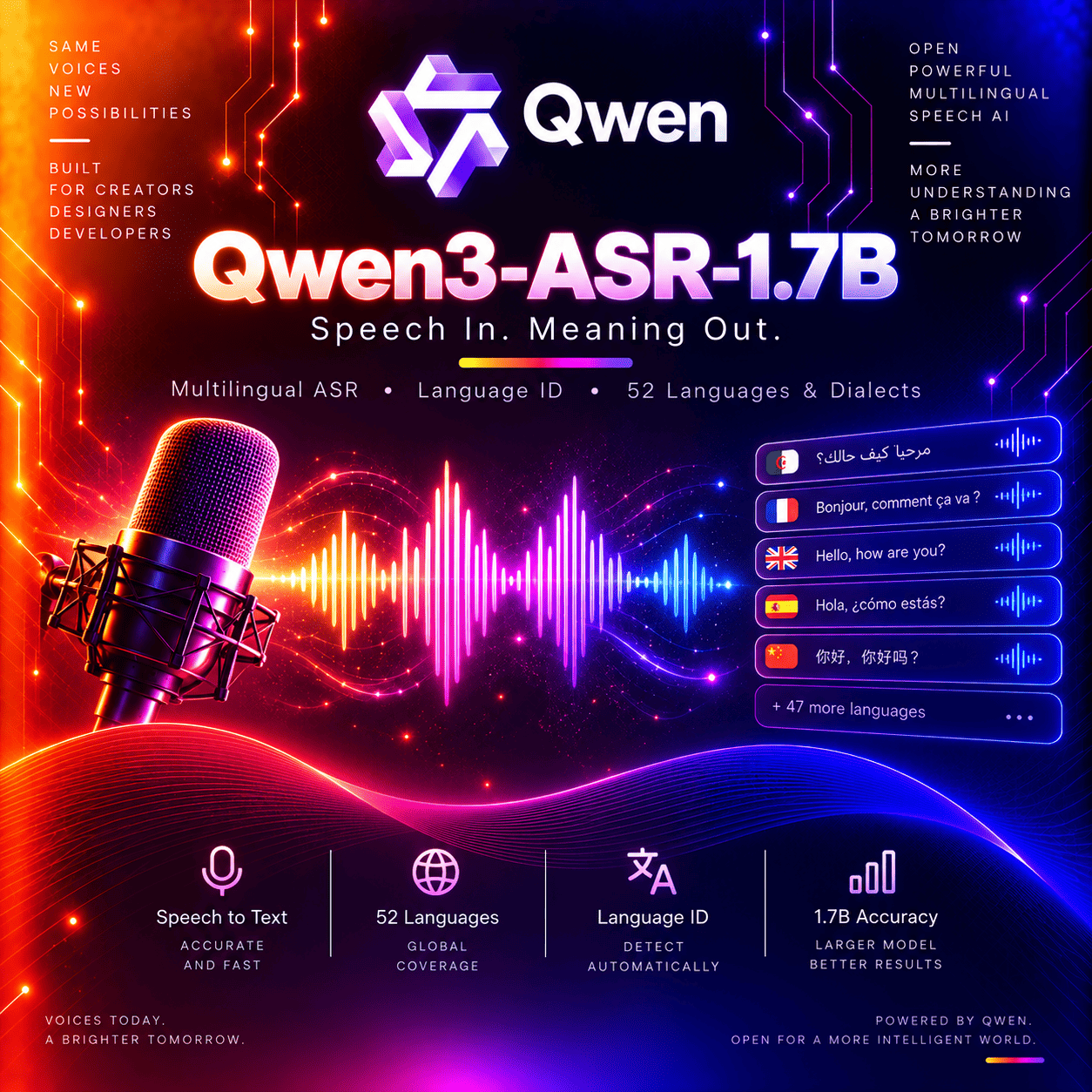
Qwen3-ASR-1.7B is the flagship model of the Qwen3-ASR family: multilingual language identification and speech recognition across 30 languages and 22 Chinese dialects, built on Qwen3-Omni. It reaches state-of-the-art accuracy among open-source ASR models (competitive with strong commercial APIs), with unified streaming/offline inference and segment- and word-level timestamps.

Nemotron 3.5 ASR Streaming Multilingual is an open 0.6B-parameter prompt-conditioned cache-aware FastConformer-RNNT model, engineered for low-latency streaming transcription across 40+ languages. It powers real-time captioning, voice agents, and multilingual transcription pipelines—replacing separate per-language Whisper deployments with a single inference pass.

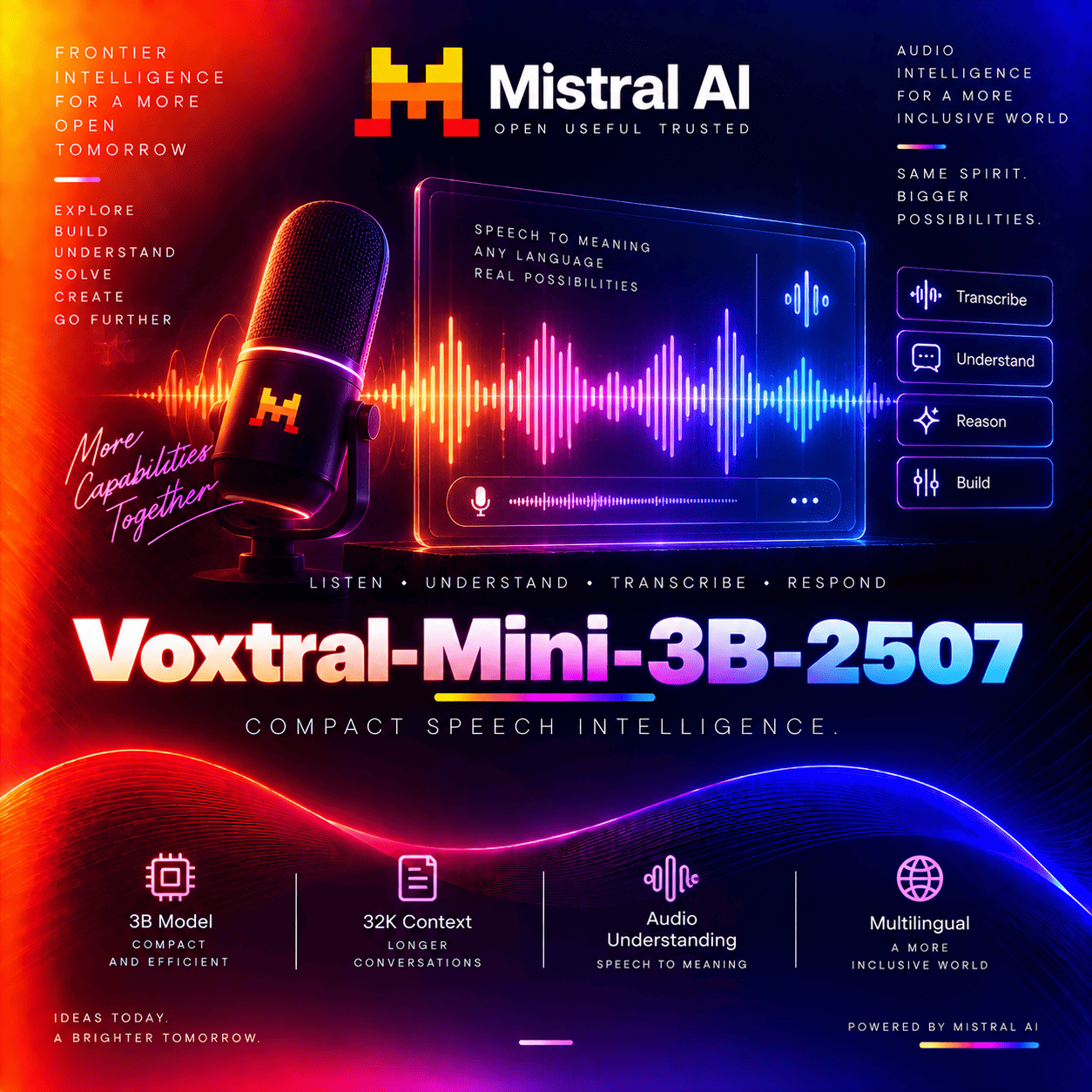
Voxtral Mini puts audio understanding on a consumer graphics card. Three billion parameters and roughly 9.5 GB of memory — against fifty-five for the larger model in the family — with the same audio feature set: dedicated transcription mode, automatic language detection across eight languages, thirty minutes of audio for transcription or forty for understanding, and function calls triggered directly from spoken intent. What you trade is the language backbone underneath. It hears about as well; it reasons about what it heard at three billion parameters rather than twenty-four.
Voxtral Small is Mistral Small 3 with ears. It transcribes speech, and — more unusually — it reasons about audio directly: ask a question about a recording and get an answer, without an intermediate transcript and without a second model. That removes the standard two-stage pipeline where a speech recogniser produces text and a language model reads it, along with everything lost at the handover. A 32k window holds thirty minutes of audio for transcription or forty for understanding, spoken intent can trigger function calls with no transcription step in between, and the text capability of its backbone is retained intact.

Whisper large-v3 is the accuracy benchmark for open speech recognition, and the reason is its training data rather than its size: five million hours of audio, most of it messy real-world recording rather than clean studio material. That makes it unusually resistant to the things that break other transcribers — background noise, accents, overlapping speakers, phone-quality audio. It handles 99 languages, detects the spoken language on its own, and returns per-sentence timestamps alongside the text. It can also translate any supported language directly into English text in a single pass. Released under Apache 2.0, it remains the default choice when transcription accuracy matters more than speed.

Whisper is a state-of-the-art model for automatic speech recognition (ASR) and speech translation, proposed in the paper "Robust Speech Recognition via Large-Scale Weak Supervision" by Alec Radford et al. from OpenAI. Trained on >5M hours of labeled data, Whisper demonstrates a strong ability to generalise to many datasets and domains in a zero-shot setting. Whisper large-v3-turbo is a finetuned version of a pruned Whisper large-v3. In other words, it's the exact same model, except that the number of decoding layers have reduced from 32 to 4. As a result, the model is way faster, at the expense of a minor quality degradation.


