Model Library
Browse and deploy state-of-the-art AI models through the DEVUP Gateway.
Loading models...
Model Library
Browse and deploy state-of-the-art AI models through the DEVUP Gateway.
Browse and deploy state-of-the-art AI models through the DEVUP Gateway.

GPT-6 Sol brings the training methods of OpenAI's flagship to a tier meant to be used far more often. Its most consequential change is not in the model but around it: reasoning effort and tool availability can now be altered mid-conversation without invalidating the prompt cache, which makes starting cheap and escalating only on the hard step a workable pattern rather than a costly one. Reasoning runs from none through max, the context window holds 1.05 million tokens with 922,000 available for input, and OpenAI report roughly half the factual errors of its predecessor alongside lower rates of agents claiming work they did not do.


MiMo-V2.6-Pro is the flagship of Xiaomi's September 2026 release, and the only model in its series with an independent measurement behind it — a score of 46 that places it at the top of open-weight models. It carries 1.02 trillion parameters with 42 billion active across 384 experts, seventy layers of which sixty use a narrow sliding window and ten see the whole context. It shares its smaller sibling's three encoders for image, video, and audio, its seven-token speculative drafter, and the single reinforcement learning run spanning coding, agents, vision, and cybersecurity. Where the two diverge is sustained consistency across large, interconnected changes. MIT licensed.
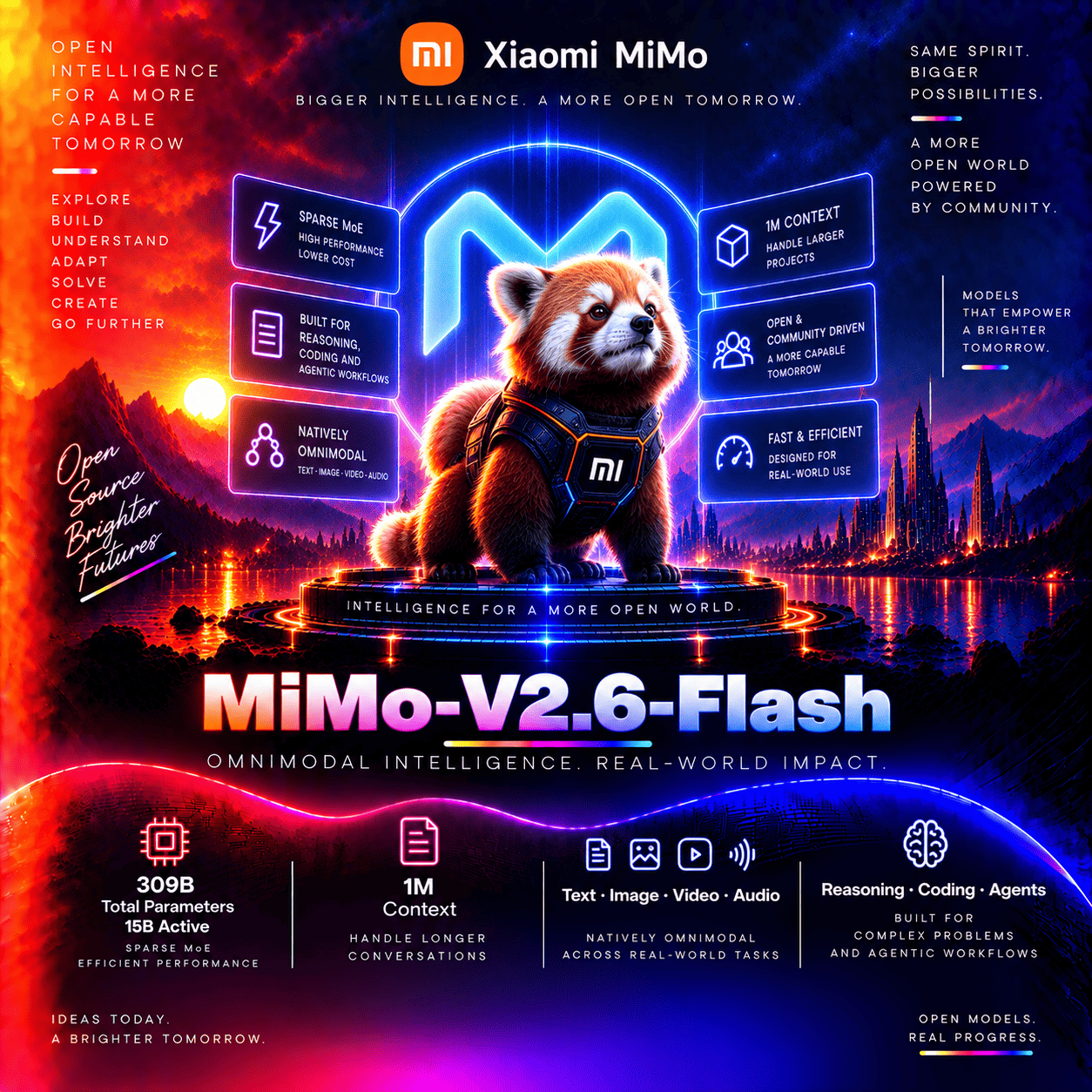
MiMo-V2.6-Flash was released on 21 September 2026 and trained through a single mixed reinforcement learning run that folded coding, general agents, visual tasks, and cybersecurity into one pass rather than separate domain-specific runs. It reads text, images, video, and audio through three dedicated encoders, across a million-token window with up to 131,072 tokens of output. Three hundred and nine billion parameters with fifteen active, two hundred and fifty-six experts with no shared expert, and a five-layer drafter predicting seven tokens per pass. MIT licensed. Its benchmark figures are, so far, Xiaomi's own.

Qwen3.8-Flash is a multimodal Mixture-of-Experts model and an early preview of the architecture behind Qwen4. It carries 125 billion main parameters plus a separate 51-billion-parameter N-gram embedding table, yet activates only 6 billion per token — under five percent — through a hybrid attention design where three of every four layers compress history and the fourth retrieves from it precisely. The result is a model that reads text, images, and video across a one-million-token context at a per-token cost closer to a small model than a large one. Thinking is on by default and switchable off, and the whole design targets agentic coding, long-document work, and video analysis.

GPT-4o mini is a fast, affordable small model for focused tasks — and its appeal is what it leaves out. There is no reasoning pass, no effort level, no deliberation budget to tune: it reads the prompt and answers, which makes its latency predictable and its behaviour easy to reason about. It accepts text and images against a 128,000-token context window, returns structured output against a JSON schema, calls functions, and supports predicted outputs for edit-style tasks. It is also built for fine-tuning: outputs from a larger model can be distilled into it to produce comparable results on a narrow task at lower cost and latency.

GPT-5.4 Pro is the deep-reasoning variant of GPT-5.4, and it asks two things of your integration before it asks anything of your prompt: it is reachable only through the responses endpoint, and its requests take minutes rather than seconds. Both are deliberate. It exists for problems that resist a quick answer — multi-step analysis, architectural judgment, questions where a confident wrong answer is more expensive than a slow right one. Three effort levels are available, starting at what other tiers treat as substantial deliberation, and OpenAI recommends submitting work in the background rather than holding a connection open for the duration.
GPT-5.5 Pro is the same underlying model as GPT-5.5 with one thing fixed rather than configurable: execution mode. Every request runs in pro mode, where the model does substantially more internal work before committing to a single final answer. That fixed choice is why it exists as its own model identifier instead of a parameter. It has no fast path — the shallowest effort level accepted is already what other tiers treat as a deliberate escalation — and requests routinely take minutes rather than seconds. It is the model for questions where a wrong answer is more expensive than a slow one.
GPT-5.3-Codex is OpenAI's most capable agentic coding model, and it is built for a narrower job than a general assistant: writing, debugging, and shipping software inside a coding agent. It merges the software-engineering strength of the previous Codex model with the broader professional reasoning of the general tier, and the result works autonomously for hours rather than turns. Compaction support lets a session run past what a context window would normally allow, and you can steer it mid-execution rather than waiting for it to finish and starting over. Reasoning is always on, across four depth levels, with the middle setting recommended for everyday interactive work.
GPT-5.4 nano is the smallest model in the GPT-5.4 family, built for the tasks where speed and cost decide whether a design is possible at all: classification, data extraction, ranking, and subagents. It answers immediately by default, with no reasoning pass, and exposes the same five effort levels as the tiers above it should a particular path need more. It accepts text and images across a 400,000-token context window and supports schema-constrained output, so structured extraction needs no parsing layer behind it. On DEVUP AI it is the model to reach for when the same operation runs thousands of times and the cost of each one is what you are actually optimising.

GPT-5.4 Mini brings the strengths of the full GPT-5.4 model into a faster, more efficient form built for high-volume workloads. OpenAI positions it as its strongest mini model yet for coding, computer use, and subagents — the roles where a model runs many times rather than once, and where latency and cost per call decide whether a design is viable at all. It shares the same five reasoning effort levels as the tier above it, defaults to no reasoning for speed, and adds a verbosity control that shapes answer length independently of thinking depth. Text and images in, text out, across a 400,000-token context window.
GPT-5.4 is OpenAI's more affordable model for coding and professional work, and it differs from the tier above it in one way that shapes every integration: it defaults to no reasoning at all. Where the flagship deliberates unless told otherwise, this model answers immediately unless you ask it to think — which makes it fast and cheap by default, and easy to under-configure by accident. It brings dedicated coding-model capabilities into a general model: production-quality code, multi-file changes with fewer retries, and stronger document and spreadsheet work. It carries a context window slightly beyond a million tokens, accepts text and images, and adds a verbosity control that shapes answer length independently of reasoning depth.
GPT-5.5 was OpenAI's flagship for complex professional work, and it earned that position on persistence rather than raw capability. Where earlier models answered a hard question, this one was built to stay in the loop — find information, judge what matters, use tools, check its own output, and keep going. It carries a context window slightly beyond a million tokens with a 128,000-token output ceiling, accepts text and images, and reasons across five effort levels from none through extended analysis. It also knows more than almost anything measured against it, and answers confidently more often than it should. That combination is the single most important thing to understand before deploying it.

GLM-4.7 is Z.ai's coding-focused open model, and the generation where thinking became something you control rather than something the model does. It introduced three distinct modes: reasoning before every response and every tool call, retaining reasoning across multi-turn sessions instead of re-deriving it, and switching deliberation on or off per turn within a single conversation. Those controls exist because the target workload is long agentic coding — multi-file changes, terminal tasks, and sessions where losing the thread costs more than any single wrong answer. It carries 358 billion parameters under an MIT licence and shows its largest gains over its predecessor exactly where sessions run long.

DeepSeek V4.1 Flash is a multimodal Mixture-of-Experts model built around one goal: making the memory cost of long context collapse. It carries 552 billion backbone parameters but activates only 8 billion per token while reading your input and 16 billion while writing its answer — an asymmetry made possible by a causal encoder-decoder design where the decoder's key-value cache is projected from the encoder's final states rather than rebuilt layer by layer. The result is 890 bytes of cache per token, roughly a quarter of the previous generation and a fraction of a percent of where the series began. Reasoning effort is a continuous integer from 1 to 100 rather than a handful of preset levels, so cost and accuracy can be tuned rather than chosen from a menu.
GPT-5.6 Sol is the flagship of OpenAI's GPT-5.6 family and the model the bare gpt-5.6 alias resolves to. What separates it from the two tiers below is not the envelope — all three share the same context window, output ceiling, input types, and six reasoning levels — but persistence. It is built to stay coherent through multi-hour agent sessions rather than stopping early, and it reaches frontier results while emitting fewer output tokens than its predecessors needed. It reasons across six effort levels, carries its chain of thought between turns when you let it, and offers a separate pro execution mode for work where reliability outweighs latency. Text and images in, text out, against a context window slightly beyond a million tokens.
GPT-5.6 Terra is the balanced tier of OpenAI's GPT-5.6 family: more capability than the efficiency model, at a fraction of the flagship's cost, on an interface identical to both. All three tiers share the same context window, output ceiling, input types, and six reasoning effort levels — so routing between them is a change to one field, not a re-integration. Terra is positioned as the practical default for everyday production traffic: application features, internal tooling, support automation, and the routine steps of a longer agent run. It reasons across six levels from none through maximum, accepts text and images, supports structured outputs and function calling, and can carry its reasoning across turns to improve both multi-turn quality and cache efficiency.
GPT-5.6 Luna is the efficiency tier of OpenAI's GPT-5.6 family, built for workloads measured in volume rather than difficulty. Its distinguishing feature is the range of control it gives you over deliberation: six reasoning effort levels, from none at all through to maximum, selectable per request. That span is unusually wide — the same model identifier serves a real-time chat endpoint that must answer instantly and a batch analysis job that can afford to think for minutes. It accepts text and images against a context window slightly beyond a million tokens, supports structured outputs and function calling, and works through both the standard chat interface and OpenAI's newer Responses API.

Ling-3.0-flash-VL adds image and video understanding to Ling-3.0-flash, and the interesting part is that vision did not sit alongside the language model — it raised it. On the Artificial Analysis intelligence index the visual model scores 42 against 38 for the text model it was built from, on the same 124-billion-parameter foundation with only 5.5 billion active per inference step. A vision encoder feeds a two-layer projector that aligns visual features with text, while a space-and-time positional encoding handles video. What it was built to do is act on what it sees: read a design reference and write the interface, render the result and compare it against the original, identify elements on a screen and operate them.
DeepSeek V4 Flash Vision Exp is an experimental vision-enabled build of V4 Flash, and it takes an unusual approach to image cost: every image is capped at 384 tokens regardless of its resolution. A two-megapixel scan and a twenty-five-megapixel one bill identically, because both are resized to the same working size before inference. That turns document processing from an open-ended cost into arithmetic you can do before sending the request. It accepts up to six hundred images per call, matches the text model it is built on across agents, reasoning, and world knowledge, and holds the same million-token context. On DEVUP AI it is the choice when the workload is pages rather than paragraphs.

GLM-5.3 is Z.ai's flagship coding model, and it makes an unusual argument: it shares its base model entirely with the previous generation. No new pre-training, no larger foundation — every gain comes from post-training alone, and the gains are large. Terminal Bench 3.0 moves from 4.6 to 28.3 on identical weights. Alongside coding, Z.ai reports that cyber capability emerged faster than expected during that scaling, putting the model at the state of the art for vulnerability discovery and more than doubling its predecessor further up the exploitation chain. It holds a one-million-token context with a 128K maximum output, generates roughly three times faster than comparable frontier models, and reasons at three selectable effort levels.
GLM-5.3-Flash is the first natively multimodal model in the GLM-5 series, and it was built from a new base model rather than adapted from an existing one. It carries 320B total parameters but activates only 18B per token, routing each token through 8 of 288 experts across 45 layers. Its defining architectural choice is a hybrid attention stack combining linear and sparse attention — a first for the series — which cuts the serving cost of very long inputs while keeping long-context accuracy intact. Trained on a 30-trillion-token multimodal corpus, it accepts images alongside text and holds a full one-million-token context. Released under the MIT license, it is the model to reach for on DEVUP AI when your input is visual, very long, or both.

Granite 4.2 8B is IBM's mid-size open reasoning model, and the smallest one in its family trained to act. Beyond the chain-of-thought reasoning shared across Granite 4.2, the 8B goes through an additional agentic reinforcement-learning stage in real sandboxed environments — editing real repositories, driving a live terminal, and running multi-hop web searches — which is why it is the smallest Granite 4.2 model with reported agentic coding results. Three thinking modes let you trade reasoning depth against latency per request, and it holds a 128K context with substantially better long-context recall than the compact tier. Tested across twelve languages and released under Apache 2.0, it is the balanced default on DEVUP AI for production agents, coding assistants, and long-document work.

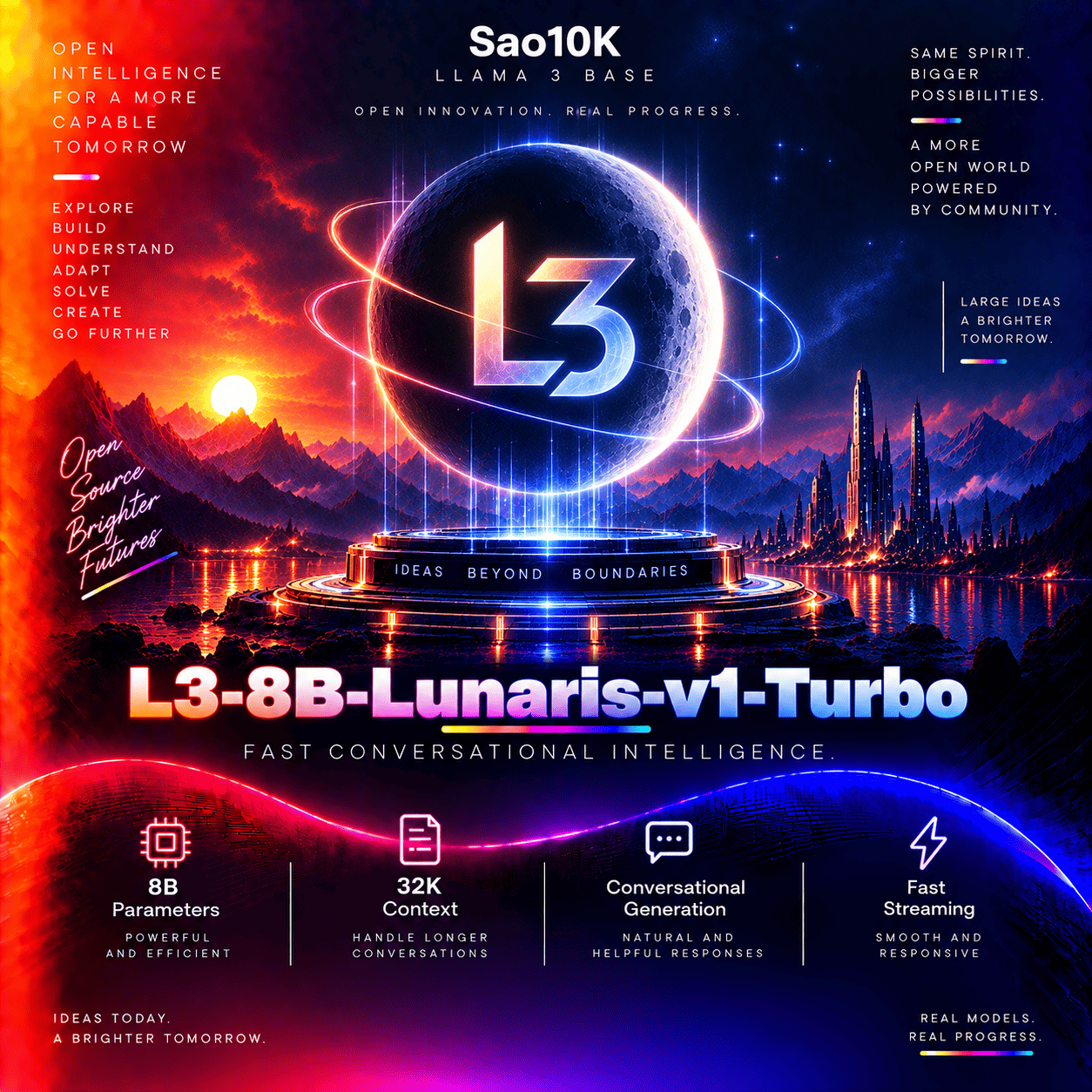
Lunaris is a merge of five Llama 3 models, made by one person, with the full recipe published — every source model, every density, every weight. Its creator describes the method candidly as black box magic, with values arrived at through years of personal experimentation rather than theory. It is built for roleplay and creative writing, and the recommended sampling reflects that: temperature 1.4, roughly ten times what most models in this catalogue suggest, held in check by a min-p floor that keeps the variance inside coherent choices. An 8,192-token window, and a model that reportedly holds its own against much larger ones at its task.
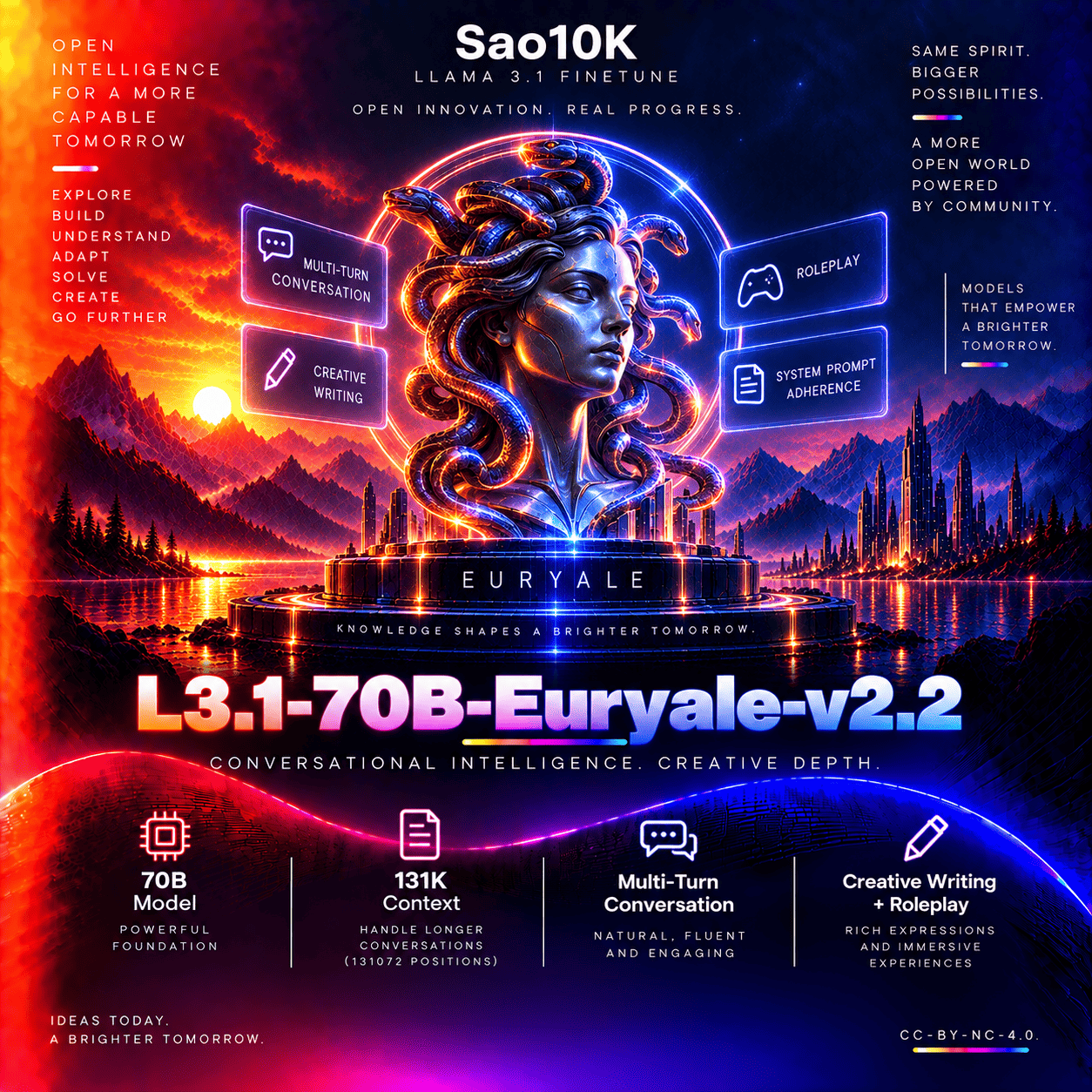
Euryale v2.2 is a trained creative model rather than a merge, built on Llama 3.1 70B by the same creator as the Lunaris merge — and the difference in method shows in what it improved. Its stated gains are multi-turn coherency, system prompt handling, and reasoning: precisely the three things that break first in a long collaborative fiction session, when a model forgets who it is playing, drifts from the scene you defined, and contradicts what happened an hour ago. Seventy billion parameters with a 131,072-token window, aimed at immersive storytelling with strong prompt adherence.


