 google /
gemma-4-31B-it
| Tier | Input | Output | Cached input |
|---|---|---|---|
PriorityLearn more | 70.2 | 205.2 | — |
FlexLearn more | 37.5 | 109.5 | — |
Gemma 4 31B is the largest dense model in Google DeepMind's open family, and it is built to read as much as it reasons. A 256,000-token context window takes entire codebases or large sets of images in one prompt, with a vision encoder that accepts variable aspect ratios rather than forcing everything into a square — which is why it handles UI screenshots, charts, and handwriting recognition rather than approximating them. Thinking is configurable rather than fixed, function calling is native, and the model was pre-trained on more than 140 languages with 35 supported out of the box. Apache 2.0, and it fits on a workstation.

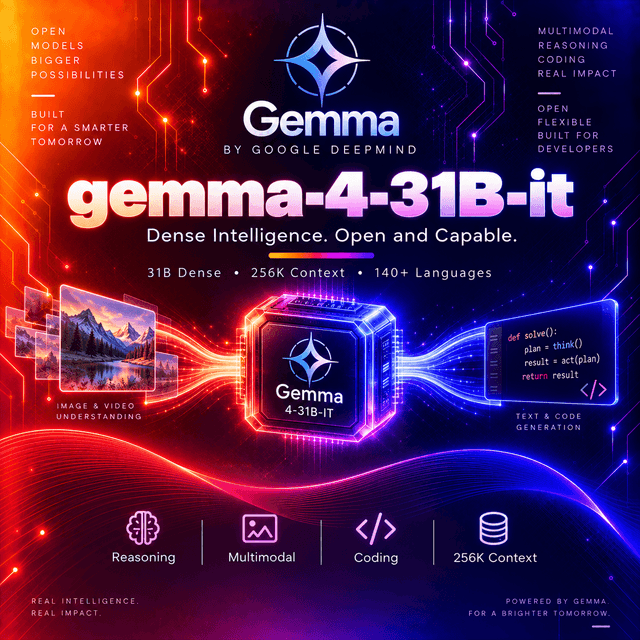
Gemma 4 31B Instruct
The largest dense model in the Gemma 4 family. 256K context, native vision, Apache 2.0, and it runs on a workstation.
Built to Read
The design brief shows in what the model accepts, not in what it scores.
A 256,000-token context window takes an entire codebase, a document set, or a large collection of images in a single prompt. Google positions this tier at consumer GPUs and workstations rather than servers — a model with server-class context on hardware you can put under a desk.
Vision is a first-class input, not an attachment. A vision encoder of roughly 550 million parameters handles variable aspect ratio and resolution — a 16:9 screenshot stays 16:9, a tall document stays tall. No preprocessing decision on your side, no detail lost to a resize you did not choose.
What that combination enables, in Google's own framing: parsing UI screens, comprehending complex charts, and multilingual OCR and handwriting recognition. Text and images interleave freely in a single prompt.
⚠️ What the Multimodal Claim Actually Covers
Read carefully, because the family description invites a wrong assumption.
| Input | Supported here |
|---|---|
| Text | ✅ |
| Image | ✅ — variable aspect ratio and resolution |
| Video | ✅ — processed as sequences of frames |
| Audio | ❌ — native on E2B, E4B, and 12B only |
Video works, through frame sequences rather than native video understanding. That distinction matters: temporal reasoning across frames is inferred rather than modelled, so fast motion and audio-visual synchronisation are outside what this handles.
Audio does not work on this model. It is native to the three smaller models in the family — which means the largest model in the lineup has a narrower input surface than the smallest. If your workload needs audio, the answer is a smaller Gemma 4, not a larger one.
Attention That Always Ends Global
The architectural choice behind the long-context behaviour.
Gemma 4 interleaves local sliding-window attention with full global attention, and Google states one constraint explicitly: the final layer is always global.
Local attention is cheap — each token sees a window, and cost stays flat as input grows. Global attention is expensive and exact. Alternating them buys most of the speed of a small model with the reach of a large one.
Fixing the last layer as global is what makes it trustworthy. Whatever the model produces, the final computation before it answers has seen the entire input rather than a neighbourhood of it.
Two memory optimisations on the global layers, which are where cache cost would otherwise concentrate:
Unified Keys and Values — shared rather than stored separately.
Proportional RoPE (p-RoPE) — positional encoding scaled for long contexts.
Benchmark Results
As published by providers hosting this model.
| Benchmark | Score | What it measures |
|---|---|---|
| AIME 2026 | 89.2% | Competition mathematics, no tools |
| LiveCodeBench v6 | 80.0% | Code generation on recent problems |
| GPQA Diamond | 84.3% | Graduate-level science |
| MMMU Pro | 76.9% | Multimodal reasoning across disciplines |
The shape here is worth reading. AIME at 89.2% and GPQA at 84.3% are results you would expect from a considerably larger model — and this one is dense, 31 billion parameters, running on a workstation.
MMMU Pro at 76.9% is the number that justifies the vision investment. It measures reasoning across images and text together rather than reading an image and answering separately, which is exactly the workload the variable-resolution encoder exists for.
AIME was measured without tools. That is the harder condition, and it means the mathematics result reflects the model rather than a calculator it was allowed to call.
Specifications
| Model ID | google/gemma-4-31B-it |
| Parameters | ~30.7B dense |
| Vision encoder | ~550M parameters |
| Context window | 262,144 tokens (256K) |
| Max output | 32,768 tokens |
| Input | Text, image, video (as frames) |
| Output | Text |
| Audio input | Not supported |
| Attention | Interleaved local sliding-window and full global; final layer always global |
| Positional encoding | Proportional RoPE |
| Reasoning | Configurable thinking mode |
| Languages | 140+ pre-trained, 35+ supported out of the box |
| Licence | Apache 2.0 |
| Developer | Google DeepMind |
Google states 31B; providers report the precise figure as 30.7B. Quantisation varies by host — FP8, INT8, and NVFP4 builds all exist, and a suffix on a model identifier frequently encodes which.
Capabilities
| Capability | Value |
|---|---|
input_types | text, image, video |
output_types | text |
audio_input | Not supported |
context_window | 262144 |
max_output_tokens | 32768 |
image_aspect_ratio | Variable |
image_resolution | Variable |
reasoning | Configurable thinking mode |
streaming | Supported |
tool_calling | Native function calling |
structured_output | JSON output — without schema enforcement |
system_prompt | Native system role support |
requires_prompt | Yes — text prompt required, media optional |
JSON Without Schema Enforcement
A precise limitation worth knowing before you build an extraction pipeline.
The model accepts response_format for JSON output. It does not enforce a JSON schema.
You get JSON. You do not get a guarantee that the JSON matches a structure you specified — no required fields, no type checking, no enum constraints applied at generation time.
What that means in practice: describe the shape in the prompt, validate what comes back, and raise rather than defaulting on a parse failure. On an extraction pipeline running at volume, a silently empty object is a wrong answer wearing the costume of no answer.
Native System Prompt Support
New in Gemma 4, and worth noting because earlier generations lacked it.
The system role is supported natively rather than emulated by prefixing instructions to a user message. Instructions go where they belong, they persist across turns without being restated, and they are separable from the conversation for logging and review.
If you are migrating a prompt that folded system instructions into the first user message — a common workaround on earlier Gemma models — move them.
Using Gemma 4 31B on DEVUP AI
Base URL: https://api.devupai.com/v1 · Model ID: google/gemma-4-31B-it
Python
import os
from openai import OpenAI

client = OpenAI(
    api_key=os.environ["DEVUP_API_KEY"],
    base_url="https://api.devupai.com/v1",
)

response = client.chat.completions.create(
    model="google/gemma-4-31B-it",
    messages=[
        {"role": "user", "content": "Hello world!"}
    ],
    max_tokens=1024,
)

print(response.choices[0].message.content)
Node.js
import DevupAI from "devupai";

const client = new DevupAI({
  apiKey: process.env.DEVUP_API_KEY,
});

async function main() {
  const response = await client.chat.completions.create({
    model: "google/gemma-4-31B-it",
    messages: [{ role: "user", content: "Hello world!" }],
    max_tokens: 1024,
  });

  console.log(response.choices[0].message.content);
}

main();
cURL
curl -X POST "https://api.devupai.com/v1/chat/completions" \
  -H "Authorization: Bearer $DEVUP_API_KEY" \
  -H "Content-Type: application/json" \
  -d '{
    "model": "google/gemma-4-31B-it",
    "messages": [
      { "role": "user", "content": "Hello world!" }
    ],
    "max_tokens": 1024
  }'
Working With Images
Two habits that matter specifically on a model with variable-resolution support.
Send images at their native dimensions. Resizing to a square before upload is a workaround for models that require it, and this one does not — the resize discards detail the encoder would have used. That is the whole point of the variable-aspect-ratio support, and pipelines carried over from other models frequently keep the resize out of habit.
Interleave text and images freely. The model was built for prompts that mix them rather than for one image followed by one question. A sequence of screenshots with commentary between them is a shape it handles natively.
For OCR and handwriting, resolution is the variable that decides success. A page sent at full size reads; the same page downscaled does not, and no prompt recovers characters the encoder never received.
Reading the Reasoning
Thinking mode is configurable rather than always on. When enabled, reasoning arrives separately from the answer.
message = response.choices[0].message

trace = getattr(message, "reasoning_content", None)
if trace:
    logger.debug("reasoning: %d characters", len(trace))

print(message.content)
Keep the fields apart in both directions. Merging reasoning into the answer breaks structured-output parsing and puts a working draft in front of readers expecting a conclusion.
Reasoning tokens count toward your output budget. With a 32,768-token ceiling and thinking enabled on a hard problem, a budget sized for the answer alone will truncate the model mid-thought.
Variants and Suffixes
Repository and model names in this family carry meaningful suffixes, and reading them wrong gets you the wrong model.
-it — instruction-tuned. The one you call.
No suffix — the pre-trained base. It does not follow instructions.
-qat-* — quantisation-aware-training checkpoints for self-hosted deployment.
Provider-specific suffixes such as -turbo are hosting conventions rather than Google
identifiers, usually encoding a quantisation. They are not part of the official model name and vary
between platforms.
Where It Fits
Whole-codebase and whole-corpus work. 256K tokens takes a repository or a document set without a retrieval layer in front of it.
Screenshot and UI analysis — parsing interfaces, reading dashboards, comprehending charts, with variable resolution removing the usual preprocessing compromise.
OCR and handwriting recognition, across languages.
Agentic workflows, with native function calling and a 256K window to hold accumulated state.
Mathematics and science, where the benchmark results land hardest.
Multilingual work — 140+ languages in pre-training, 35+ supported directly.
Self-hosted deployment, where Apache 2.0 and published quantisation checkpoints make it unusually well-equipped.
Not for audio. That lives on the smaller models in this family.
Practical Notes
Send images at native aspect ratio and resolution. The encoder handles it; resizing throws detail away.
Use the system role natively rather than prefixing instructions to a user message.
Validate JSON output yourself — schema enforcement is not applied.
Budget output tokens for reasoning plus answer when thinking is enabled.
Check the modality table before choosing by size. Audio lives on the smaller models.
Read the suffix on a model identifier. -it is instruction-tuned; anything else needs checking.
Verify long-context behaviour on your own data before relying on the far end of 256K.
Limitations
No audio input. Native on E2B, E4B, and 12B in the same family, absent here.
Video is frame sequences, not native video understanding. Temporal reasoning is inferred rather than modelled.
32,768-token output ceiling — an eighth of the context window, and shared with reasoning when thinking is enabled.
JSON output without schema enforcement. Validate what comes back.
Text output only. It reads images and video; it does not generate them.
Benchmark figures are provider-reported. Treat them as approximate and measure your own cases.
A base variant exists with a nearly identical name. Downloading the wrong one gets a model that does not follow instructions.
Quantisation varies by host. The same model at INT8, FP8, or NVFP4 does not behave identically at the margins.
Apache 2.0 is permissive, not unconditional. Read it against a commercial deployment.


