 inclusionAI /
Ling-3.0-flash
The model prioritizes token efficiency and agentic inference at production scale, stretching what developers can achieve within limited token, latency, and serving-cost budgets.
Ling-3.0-flash
We're introducing Ling-3.0-flash, our next-generation native hybrid reasoning model. Operating with 124B total and 5.1B active parameters (~12.4% and ~8.1% of our previous 1T-class flagship Ring-2.6-1T), Ling-3.0-flash matches or outperforms its predecessor across key benchmarks.
Key Highlights
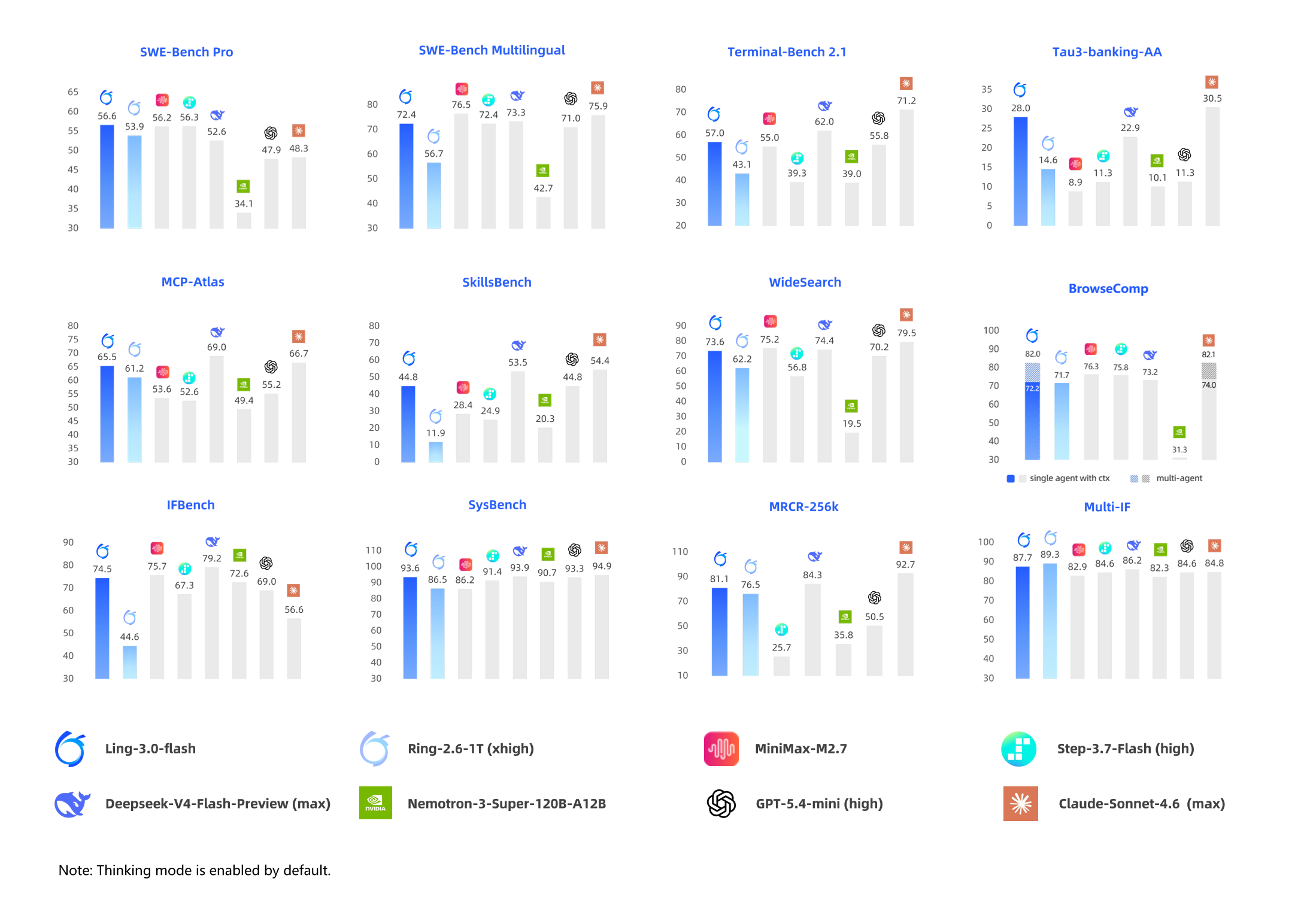
- Native Hybrid-Linear Architecture: Ling-3.0 adopts a native hybrid linear attention architecture from the very start of pretraining (5:1 alternating stacking of Kimi Delta Attention (KDA) and MLA), upgraded with KDA fine-grained diagonal gating and 1/64 sparse MoE. With 124B total parameters and 5.1B activated parameters, it achieves a synergistic leap in long-context efficiency and computational cost.
- Remarkable Efficiency & Performance: Engineered for speed, compute efficiency, and production deployment, Ling-3.0-flash delivers class-defying performance against both larger SOTA competitors and previous-generation flagships. Activating only 5.1B parameters per token, it provides impressive reasoning, instruction following, and long-context capabilities to empower complex agentic workflows in production environments.
- Comprehensive Agentic Evolution: Tailored for real-world productivity workflows, the model incorporates 10,000+ interactive training environments to achieve end-to-end closed-loop execution across Coding, General, and Deep Research Agent tasks. It natively integrates the SGLang HiCache + Mooncake hierarchical caching architecture (featuring physical dual-pools and a cluster-shared L3 cache), eliminating redundant recomputation during long-horizon interactions and reducing Time to First Token (TTFT) by 60% to over 80% in long-input scenarios.
Model Overview
The model summary information and architecture diagram are as follows:
| Property | Value |
|---|---|
| Architecture | Hybrid-linear MoE |
| Parameter Scale | Total 124B, Activated 5.1B |
| Transformer Layers | 35 KDA + 7 Gated MLA (5:1) |
| Number of Dense Layers | 2 |
| Number of Routed Experts | 512 |
| Number of Shared Experts | 1 |
| Number of Activated Experts | 8 |
| Attention Heads | 32 |
| Hidden Size | 2560 |
| Expert Intermediate Size | 768 |
| Dense Intermediate Size | 6144 |
| Vocabulary Size | 157184 |
| Context Training Schedule | 8K → 32K → 256K |
Evaluation
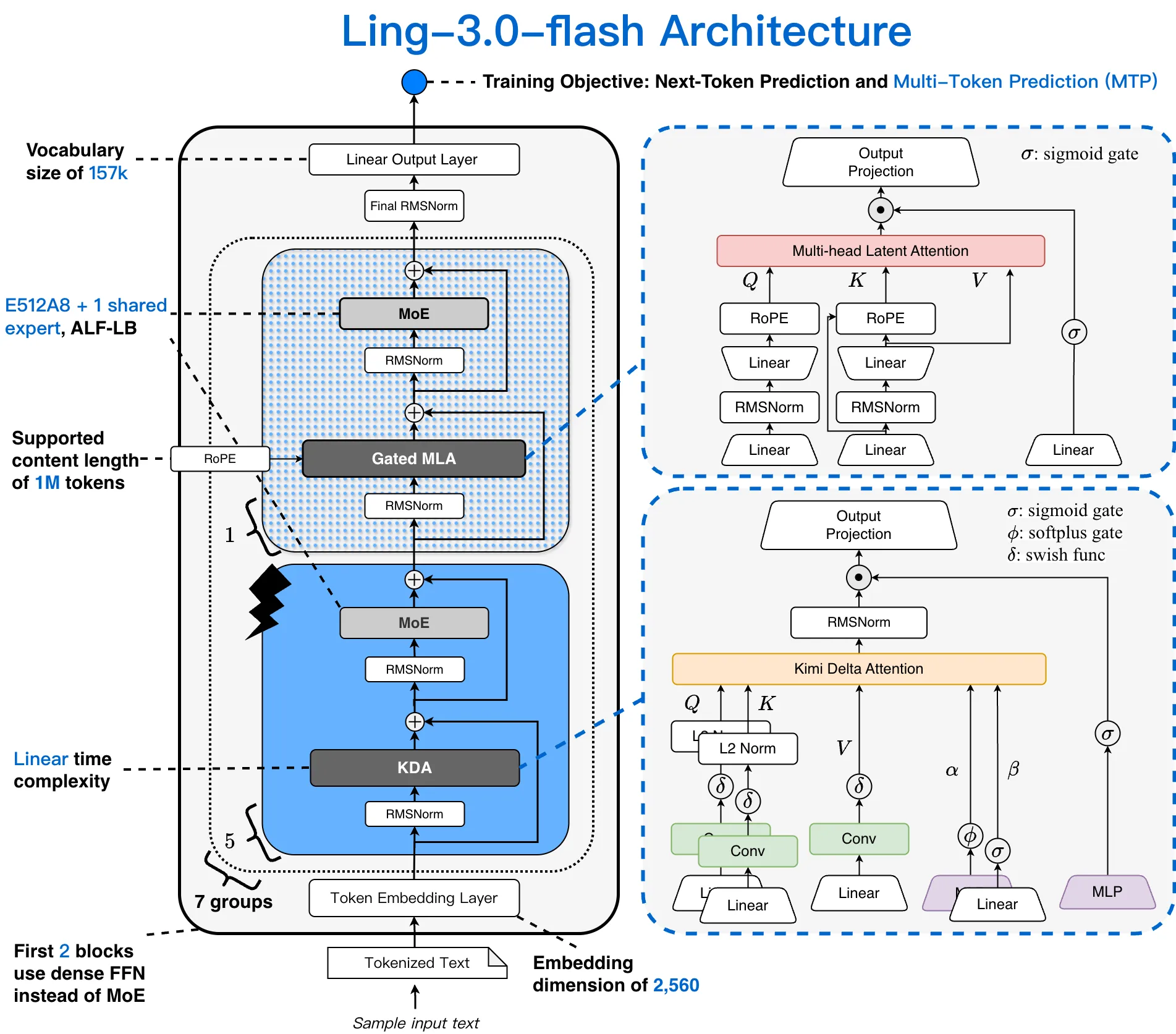
A comprehensive evaluation of Ling-3.0-flash has been conducted across multiple authoritative benchmarks. Ling-3.0-flash performs strongly on representative code/agent benchmarks such as SWE-Bench Pro, SWE-Bench Multilingual, Tau3-banking-AA, MCP-Atlas, and SkillsBench, etc. In practice, Ling-3.0-flash delivers a strong user experience across frameworks including Claude Code, Kilo Code, Qwen Code, Hermes Agent, and OpenClaw, etc. Beyond agentic tasks, Ling-3.0-flash also delivers strong performance across general knowledge, mathematical reasoning, instruction following, and long-context understanding.
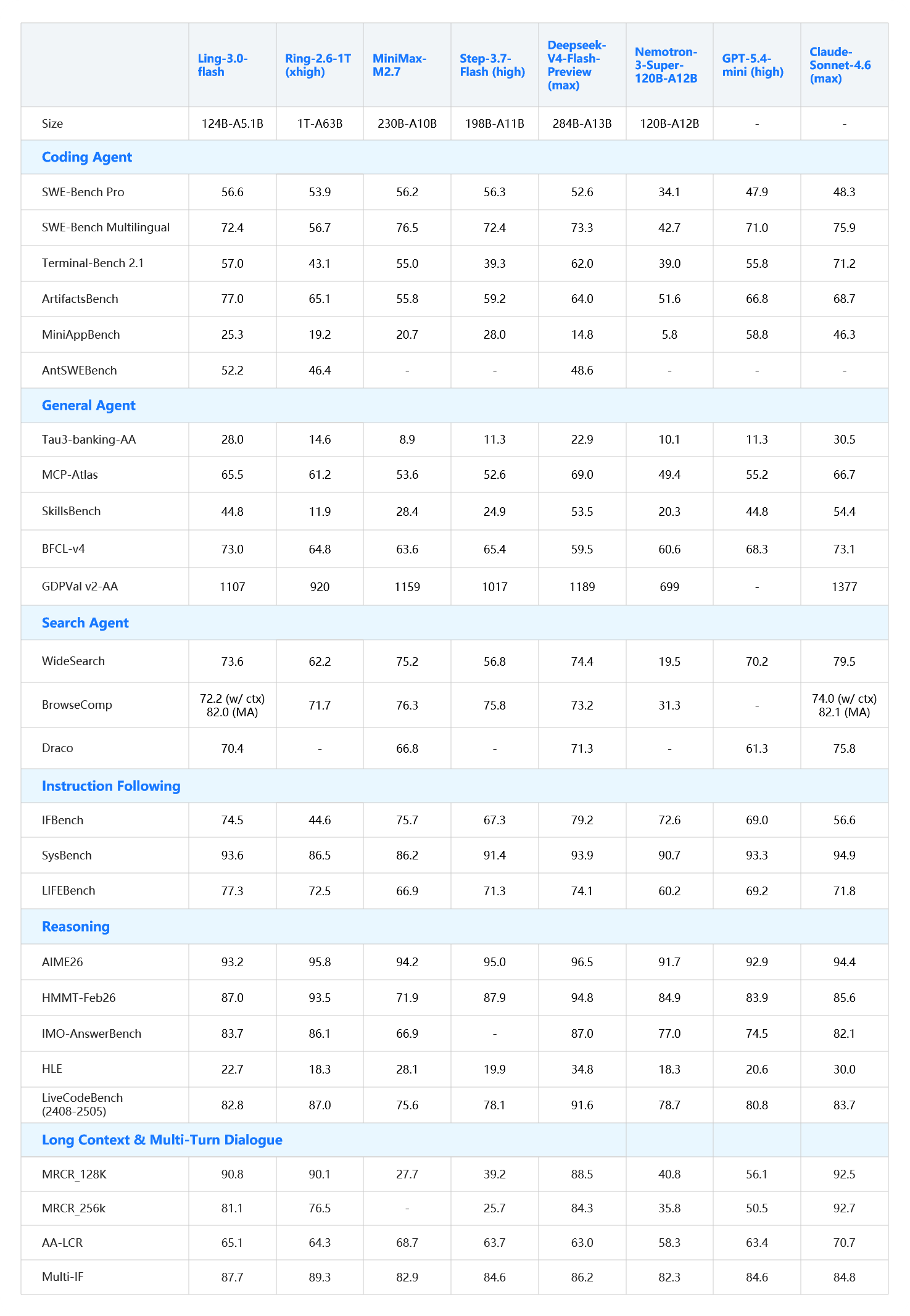
Thinking mode is enabled by default. Unless otherwise specified, the default parameters for Ling-3.0-flash are:
temperature=0.6,top_p=0.95,top_k=20.
Benchmark Evaluation Notes
- SWE-Bench Series: Evaluated using OpenHands as the agent harness with tailored prompts. Decoding uses
temperature=0.6,top_p=0.95,max_new_tokens=32K, with a 256K context window. - Terminal-Bench 2.1: Evaluated under the Artificial Analysis (AA) protocol using the default Terminus 2 harness, a unified 2-hour timeout, the provided JSON parser in preserve-thinking mode, and 3 runs per task (mean). Decoding uses
temperature=0.6,top_p=1.0,max_new_tokens=32K, with a 256K context window. - MiniAppBench: A 500-task coding benchmark evaluating whether models can turn a single user request into complete, usable interactive HTML apps in real-world application-generation scenarios. Evaluated with
temperature=1.0,top_p=1.0,max_tokens=128K. - AntSWEBench: An internally used software engineering benchmark that covers mainstream programming languages such as Java, JavaScript, and Python, including various development scenarios like new feature, bug fix, and code refactoring.
- Tau3-banking-AA: Aligned with the AA leaderboard, utilizing GPT-5.4-mini (medium reasoning) for both the user simulator and the natural-language assertion judge.
- MCP-Atlas: Evaluated on the 500-task public set using the official v1 harness with a 20-turn limit and Gemini-2.5-Pro as the claim-coverage judger.
- SkillsBench: Evaluated via kilo-code on 87 tasks (excluding external API-dependent tasks), averaged over 3 runs.
- GDPval v2-AA: Evaluated on the public 220-task benchmark using the official Stirrup harness, with a 250-turn limit and a 5-hour timeout.
- Search-agent: For all search-agent tasks, evaluations are performed using an internal harness. The basic ReAct paradigm is adopted for single-agent evaluation, while a multi-agent setup is employed for BrowseComp. The reported metric is the average pass@1.
- WideSearch: Evaluated using the official prompt and the official judge model GPT-4.1 on the corrected version of the dataset.
- Draco: Scored based on official rubrics per question, with the final score calculated as the average across all questions using Claude Opus 4.6 as the scoring model.
- BrowseComp (Single-Agent): Evaluated using a resume strategy for context management: once the context reaches a 64K-token threshold, the trajectory is summarized, the original history is discarded, and execution is resumed from the summary.
- BrowseComp (Multi-Agent): Evaluated on English and ZH Revised datasets using an internal multi-agent search harness based on SearchSwarm/Tongyi DeepResearch, configured with
temperature=0.85,top_p=0.95,max_tokens=8K, and main/sub-agent context windows of 128K and 64K, respectively.
Quantized Models
The quantized models are evaluated using several datasets. The FP8 quantized model is applied via blockwise quantization, and INT4 and FP4 models are applied via groupwise quantization with routed experts weights.
| Dataset | BF16 | FP8 | INT4 | FP4 |
|---|---|---|---|---|
| GPQA-diamond | 84.97 | 84.00 | 83.65 | 82.42 |
| IFBench | 73.40 | 73.40 | 72.20 | 72.33 |
| SciCode | 41.24 | 40.37 | 39.35 | 39.79 |
| ArcPrize | 68.75 | 67.18 | 67.56 | 64.16 |


