 thinkingmachines /
Inkling-2-Mini
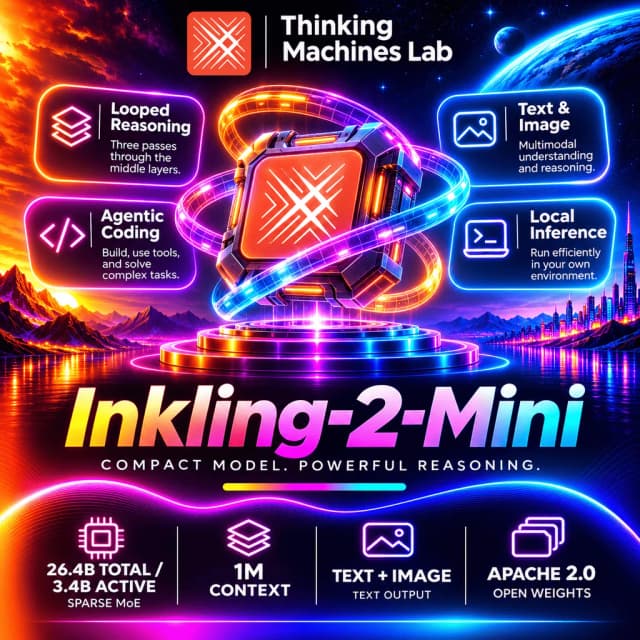
Thinking Machines Lab's first looped transformer: a 26.4B Mixture-of-Experts with 3.4B active parameters whose middle layers run three times per token. Reads text, images and PDFs across a 1M-token context, reasons by default and can switch reasoning off — built for agents, coding assistants and document work at low cost.
- Tools
- Vision
- PDF input
- Reasoning
- Structured output
- Reasoning
- On by default
reasoning_effort- none
- low
- medium
- high
- xhigh
Can be turned off
Use Inkling-2-Mini in VS Code, Cursor and Antigravity
DEVUP Code, the DEVUP AI extension, is free to install. Requests are paid from your DEVUP balance.
Inkling 2 Mini

Inkling 2 Mini is the smallest model in Thinking Machines Lab's Inkling 2 line, and the lab's first looped transformer. It reads text, images and PDFs and writes text, with a context of 1,048,576 tokens.
Its defining trick is that the middle of the network runs three times for every token. Of 26.4B parameters only 3.4B are active per token, but because those middle layers are applied three times, each token gets the compute of roughly 5.4B active parameters. Thinking Machines describes the effect as letting the model "reason longer without writing its reasoning down" — it reaches answers in fewer visible tokens, especially on agentic coding.
It is aimed at agents and tool use, coding assistants, chatbots and retrieval-augmented generation. Thinking Machines released it on 20 November 2026 with open weights under Apache 2.0.
At a glance
| Model type | Multimodal looped transformer, sparse Mixture-of-Experts |
| Total parameters | 26.4B |
| Active per token | 3.4B (about 5.4B effective, counting the three passes) |
| Layers | 24 stored, 48 applied per token |
| Experts | 8 of 128 per token |
| Attention | Hybrid local and global |
| Numerics | NVFP4, last layers MXFP8 |
| Input | Text, images, PDF |
| Output | Text |
| Maximum context size | 1,048,576 tokens |
| Maximum output | 1,048,576 tokens |
| Reasoning | On by default, can be switched off |
| Released | 20 November 2026 |
| License | Apache 2.0 |
Prompt and reply come out of one shared budget of 1,048,576 tokens.
Getting started
curl https://api.devupai.com/v1/chat/completions \
  -H "Authorization: Bearer $DEVUP_API_KEY" \
  -H "Content-Type: application/json" \
  -d '{
    "model": "thinkingmachines/Inkling-2-Mini",
    "messages": [
      { "role": "user", "content": "Write a Python function that merges overlapping time intervals, with tests." }
    ]
  }'
Python, using the OpenAI client:
from openai import OpenAI
import os

client = OpenAI(
    api_key=os.environ["DEVUP_API_KEY"],
    base_url="https://api.devupai.com/v1",
)

response = client.chat.completions.create(
    model="thinkingmachines/Inkling-2-Mini",
    messages=[
        {"role": "user", "content": "Write a Python function that merges overlapping time intervals, with tests."}
    ],
)

print(response.choices[0].message.content)
Node.js:
import OpenAI from "openai";

const client = new OpenAI({
  apiKey: process.env.DEVUP_API_KEY,
  baseURL: "https://api.devupai.com/v1",
});

const response = await client.chat.completions.create({
  model: "thinkingmachines/Inkling-2-Mini",
  messages: [
    { role: "user", content: "Write a Python function that merges overlapping time intervals, with tests." },
  ],
});

console.log(response.choices[0].message.content);
Reasoning
By default the model thinks before it answers, at high effort. The thinking is returned separately from content, and its size appears in usage.completion_tokens_details.reasoning_tokens, billed as output.
Turning it off
reasoning_effort: "none" gives a direct answer. Four runs of a short timetable question, two through this API and two against the underlying service:
reasoning_tokens: 0 completion_tokens: 9 content: 2h 35mAll four identical, all correct, nothing but the answer in content.
Thinking Machines notes that its minimum setting does not fully disable reasoning. On short questions we saw none; on harder ones some deliberation may remain, so keep a few hundred tokens of headroom in max_tokens even with none.
Effort levels
none, low, medium, high and xhigh are accepted. Above none they behave as one setting. On the same problem, our capability test measured:
| Level | Reasoning tokens |
|---|---|
low | 441 |
medium | 508 (repeats: 475, 429, 508) |
high | 490 |
xhigh | 481 |
Three runs at medium alone vary by 79 tokens — more than the distance between levels. There is no ladder to climb: pick reasoning on or reasoning off.
This fits the design. Much of the model's extra thinking happens inside the looped layers, before any token is written, so the visible reasoning is already short and does not stretch with effort.
Images
Images are sent as image_url parts, by link or as base64. Thinking Machines recommends each side be between 40 and 4,096 pixels.
curl https://api.devupai.com/v1/chat/completions \
  -H "Authorization: Bearer $DEVUP_API_KEY" \
  -H "Content-Type: application/json" \
  -d '{
    "model": "thinkingmachines/Inkling-2-Mini",
    "messages": [{
      "role": "user",
      "content": [
        { "type": "text", "text": "List the line items and amounts on this receipt." },
        { "type": "image_url", "image_url": { "url": "https://example.com/receipt.jpg" } }
      ]
    }]
  }'
Document reading is a strength: Thinking Machines reports 92.8% on OmniDocBench v1.6, and 76.5% on ScreenSpot Pro for locating interface elements in screenshots.
PDF documents
PDF files are accepted as file parts:
import base64

with open("contract.pdf", "rb") as f:
    pdf = base64.b64encode(f.read()).decode()

response = client.chat.completions.create(
    model="thinkingmachines/Inkling-2-Mini",
    max_tokens=4000,
    messages=[{
        "role": "user",
        "content": [
            {"type": "text", "text": "What is the notice period for termination, and in which clause?"},
            {"type": "file", "file": {
                "filename": "contract.pdf",
                "file_data": f"data:application/pdf;base64,{pdf}",
            }},
        ],
    }],
)
Tool calling
All three ways of steering a call work: tool_choice left on auto, set to "required", or naming one function.
tools = [{
    "type": "function",
    "function": {
        "name": "run_tests",
        "description": "Run the test suite for a path and return failures",
        "parameters": {
            "type": "object",
            "properties": {"path": {"type": "string"}},
            "required": ["path"],
        },
    },
}]

response = client.chat.completions.create(
    model="thinkingmachines/Inkling-2-Mini",
    max_tokens=4000,
    messages=[{"role": "user", "content": "Check whether the parser module still passes its tests."}],
    tools=tools,
    tool_choice="required",
)

for call in response.choices[0].message.tool_calls:
    print(call.function.name, call.function.arguments)
In our tests every mode returned finish_reason: "tool_calls" with valid arguments, after a short deliberation of 54 to 73 reasoning tokens.
For agents, add guard rails. Thinking Machines warns that this model is less dependable than larger ones at following detailed tool-use instructions, may take destructive actions without asking, and may misreport what it did. Run it in a sandbox, require confirmation for irreversible steps, and verify results rather than trusting its summary.
Structured output
json_schema and json_object are both honoured.
curl https://api.devupai.com/v1/chat/completions \
  -H "Authorization: Bearer $DEVUP_API_KEY" \
  -H "Content-Type: application/json" \
  -d '{
    "model": "thinkingmachines/Inkling-2-Mini",
    "max_tokens": 2000,
    "messages": [
      { "role": "user", "content": "Pull out the sender, the date and the requested action: \"From Nadia, 3 Dec: please renew the SSL certificate before Friday.\"" }
    ],
    "response_format": {
      "type": "json_schema",
      "json_schema": {
        "name": "request",
        "strict": true,
        "schema": {
          "type": "object",
          "properties": {
            "sender": { "type": "string" },
            "date": { "type": "string" },
            "action": { "type": "string" }
          },
          "required": ["sender", "date", "action"],
          "additionalProperties": false
        }
      }
    }
  }'
Make sure finish_reason is stop before you parse; a reply cut off by the cap is not valid JSON.
Prompt caching
A prefix that repeats across requests is served from cache and billed at the cached-input rate. Order messages so the fixed material — instructions, tool schemas, documents — comes first and the changing request comes last.
How looping works

The network stores 24 layers. The middle 12 share their weights across three passes, so a token goes through 48 layer applications in total. Thinking Machines found that looping the middle of the network — where more abstract processing happens — helped more than looping the final layers on 27 of 28 evaluations.
Some consequences worth knowing:
- Fewer visible tokens. Part of the reasoning happens inside the loops, so chains of thought come out shorter than a same-sized model would need.
- More compute per token than the active count suggests. Each token costs about 5.4B active parameters of compute, not 3.4B.
- Knowledge does not loop. Extra passes help long-context and multi-step tasks, but factual recall depends on parameter count, so it stays at the level of a small model.
- Native low precision. Most weights were trained and are served in NVFP4, with the last layers in MXFP8, so there is no conversion loss from a higher-precision original.
Thinking Machines also tested whether looping hides reasoning from oversight. Its preliminary finding is that, at this scale, looping adds capability without a meaningful loss in how readable and monitorable the chain of thought remains.
Benchmarks
Results reported by Thinking Machines Lab.
| Area | Benchmark | Score |
|---|---|---|
| Index | Artificial Analysis Index v5.0 | 20.1 |
| Index | Vals Index v2.2 | 46.5% |
| Coding | SWE-Bench Verified (bash only) | 79.2% |
| Coding | SWE-Bench Pro v2 (Hard) | 77.9% |
| Coding | SWE-Bench Multilingual | 73.7% |
| Coding | Terminal Bench v2.1 | 71.6% |
| Coding | DeepSWE v1.1 | 48.2% |
| Search and tools | BrowseComp (with compaction) | 79.0% |
| Search and tools | DeepSearchQA (with compaction) | 85.3% |
| Search and tools | MCP Atlas (public) | 82.7% |
| Knowledge work | GDPVal-AA v2.1 | 1319 |
| Finance | Vals Finance Index | 50.1% |
| Visual perception | ScreenSpot Pro (original / with Python) | 76.5% / 87.7% |
| Visual perception | OmniDocBench v1.6 | 92.8% |
| Visual reasoning | MMMU Pro (Standard 10) | 74.9% |
| STEM reasoning | ARC-AGI v1 / v2 | 84.5% / 49.3% |
| Long context | LongBench v2 | 66.9% |
| Long context | MRCR v2 8-needle (256K–512K) | 46.4% |
| Instruction following | ComplexConstraints v1.1 | 33.4% |
| Factuality | AA-Omniscience v1.1 (non-hallucination rate) | 63.4% |
Thinking Machines places it first among open-weight models under 100B total parameters on DeepSWE v1.1 and the Vals Index. The weak spots are visible in the same table: complex instruction following and factuality.
Common pitfalls
| Symptom | Cause | Fix |
|---|---|---|
| A coding or debugging task runs on and on | The model can fall into long reasoning loops | Cap max_tokens and the number of agent turns |
high does not think more than low | Effort levels above none are not graded | Choose reasoning on or off |
| A confident but wrong fact | Factual recall is the weakest area of a small model | Ground answers with retrieval, verify facts |
| An agent ran a destructive step | The model may act without asking | Sandbox it and confirm irreversible actions |
| Stilted or mixed-language replies | Quality drops outside English | Prefer English prompts, or a larger model |
Empty content, finish_reason: "length" | Reasoning used up the cap | Raise max_tokens, or send reasoning_effort: "none" |
Limits to keep in mind
Thinking Machines is direct about the trade-offs. Inkling 2 Mini is less capable than Inkling 2 Small on most evaluations, with the widest gap on factual recall and knowledge-heavy questions, and it may state wrong facts with confidence. It is weaker at multi-turn chat and complex instruction following, can be overly cautious on mental-health topics, and its quality drops outside English.
Like any language model it can hallucinate, carry biases from its training data, and its knowledge ends at its training cutoff.
For anything consequential — and in particular medical, legal or safety-critical decisions — evaluate it on your own task, add safeguards in your application, and keep a person reviewing the output.
Licensing
Weights are released under Apache 2.0. Use is also subject to Thinking Machines Lab's Model Acceptable Use Policy.
References
- Introducing Inkling 2 Mini — release post, with the looping design and monitorability results.
- Inkling 2 Mini model card — properties, evaluations, safety and limitations.
- Weights on Hugging Face — checkpoint and deployment guides.
- Training data documentation — sources and curation.


