Model Library
Browse and deploy state-of-the-art AI models through the DEVUP Gateway.
Loading models...
Model Library
Browse and deploy state-of-the-art AI models through the DEVUP Gateway.
Browse and deploy state-of-the-art AI models through the DEVUP Gateway.


Google DeepMind's Veo 3.1 Fast turns a text prompt into a high-fidelity, cinematic clip with synchronized audio: dialogue, sound effects and ambient sound generated with the picture. Landscape or portrait, 720p or 1080p at the same price, built for fast iteration and content at volume.

Gemma 3 4B fits in 2.6 gigabytes at int4 and carries the same vision encoder as the 27-billion-parameter model at the top of its family — frozen and shared across sizes, so perception does not shrink with the model. It reads text and images across a 128K context window on hardware where that combination is normally impossible: a phone, a single-board computer, an integrated GPU. Google describe it as competitive with the previous generation's 27B flagship. What it costs you is measurable and concentrated in hard reasoning, where the gap to the larger siblings is real.
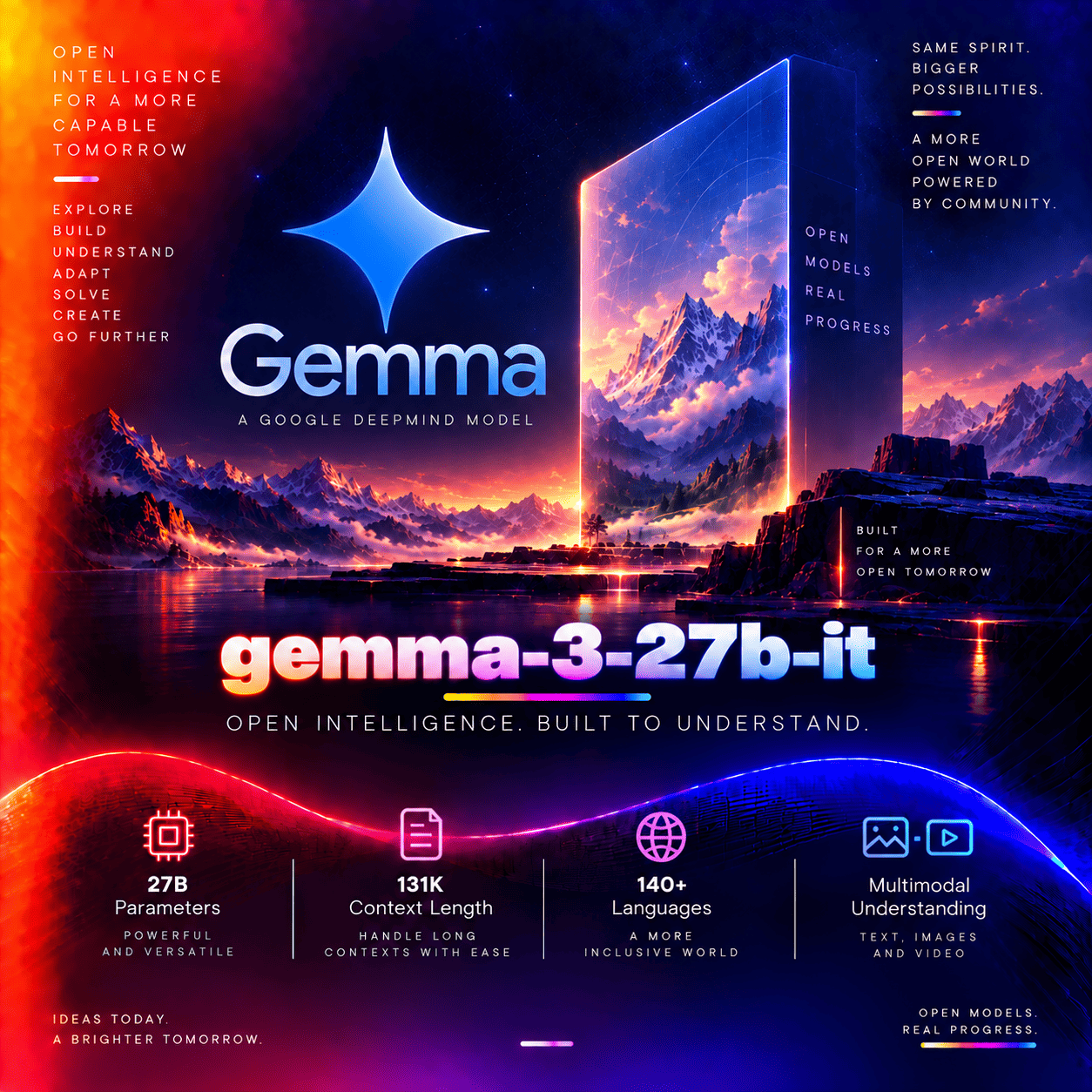
Gemma 3 27B was built to be the most capable model you can run on one GPU, and the quantisation numbers make that literal: 54 GB at bfloat16 drops to 14.1 GB at int4, which fits a desktop RTX 3090. The saving comes from quantisation-aware training rather than a conversion applied afterwards, so quality stays close to full precision. Its 128K context rests on a 5:1 ratio of local to global attention layers — a design Google measured as cutting KV-cache overhead from sixty percent to under fifteen. It reads text and images across 140 languages, with an 8,192-token output ceiling.

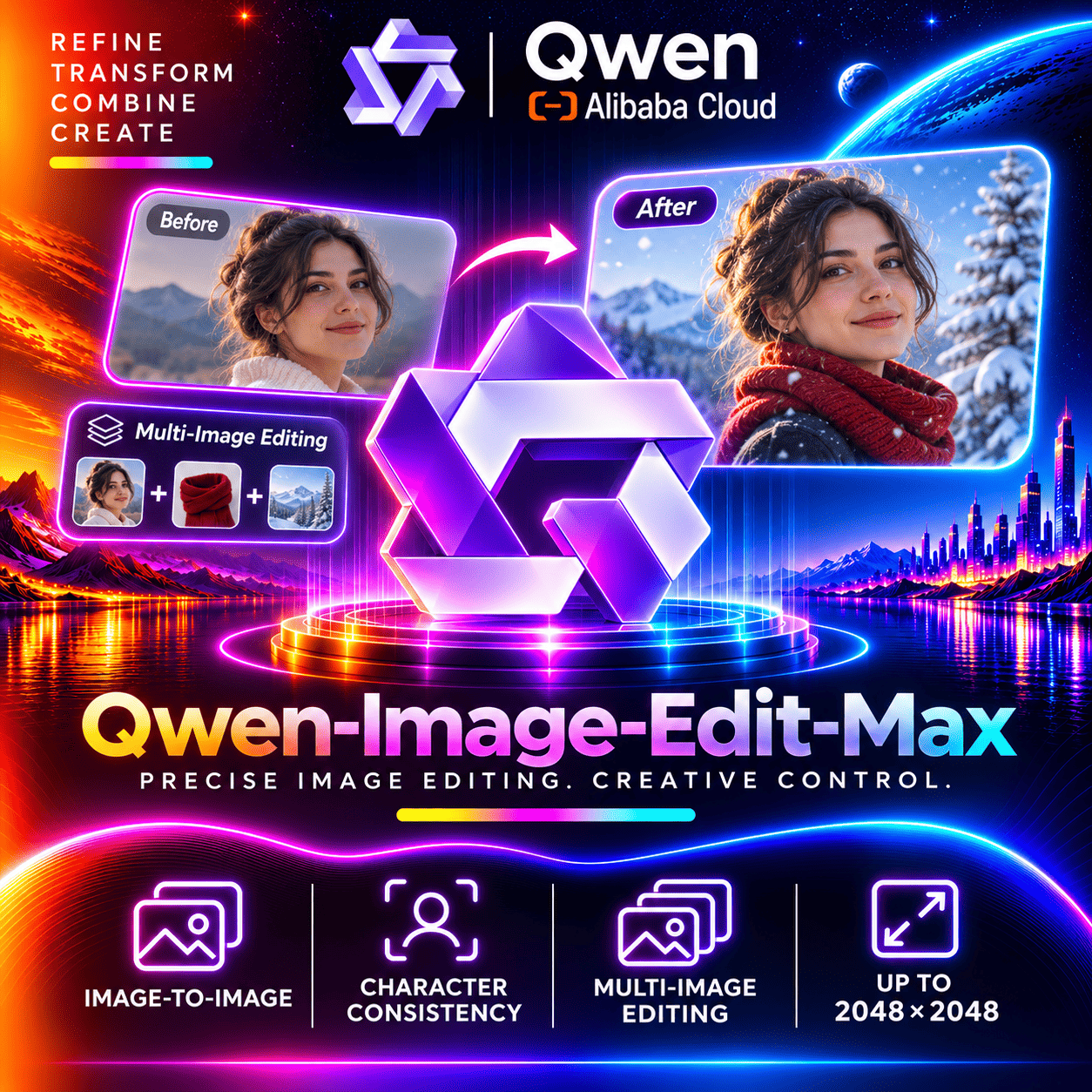
Qwen-Image-Edit-Max is the top image-editing model of Alibaba's Qwen-Image line: edits from plain instructions on 1 to 3 input images, up to 4 results per request, with an optional built-in prompt rewrite.
Qwen3.5-9B fits a 262,144-token window and a vision encoder onto a single 24 GB card. Thirty-two layers, twenty-four of them linear attention carrying sequence state at constant cost, with full attention on every fourth — a layout the configuration publishes explicitly as a per-layer list rather than leaving implicit. The vision tower is the same twenty-seven-block encoder its much larger siblings use, which means perception does not shrink with the model. It is the smallest dense member of its family that keeps reasoning and tool calling intact, across 201 languages under Apache 2.0.
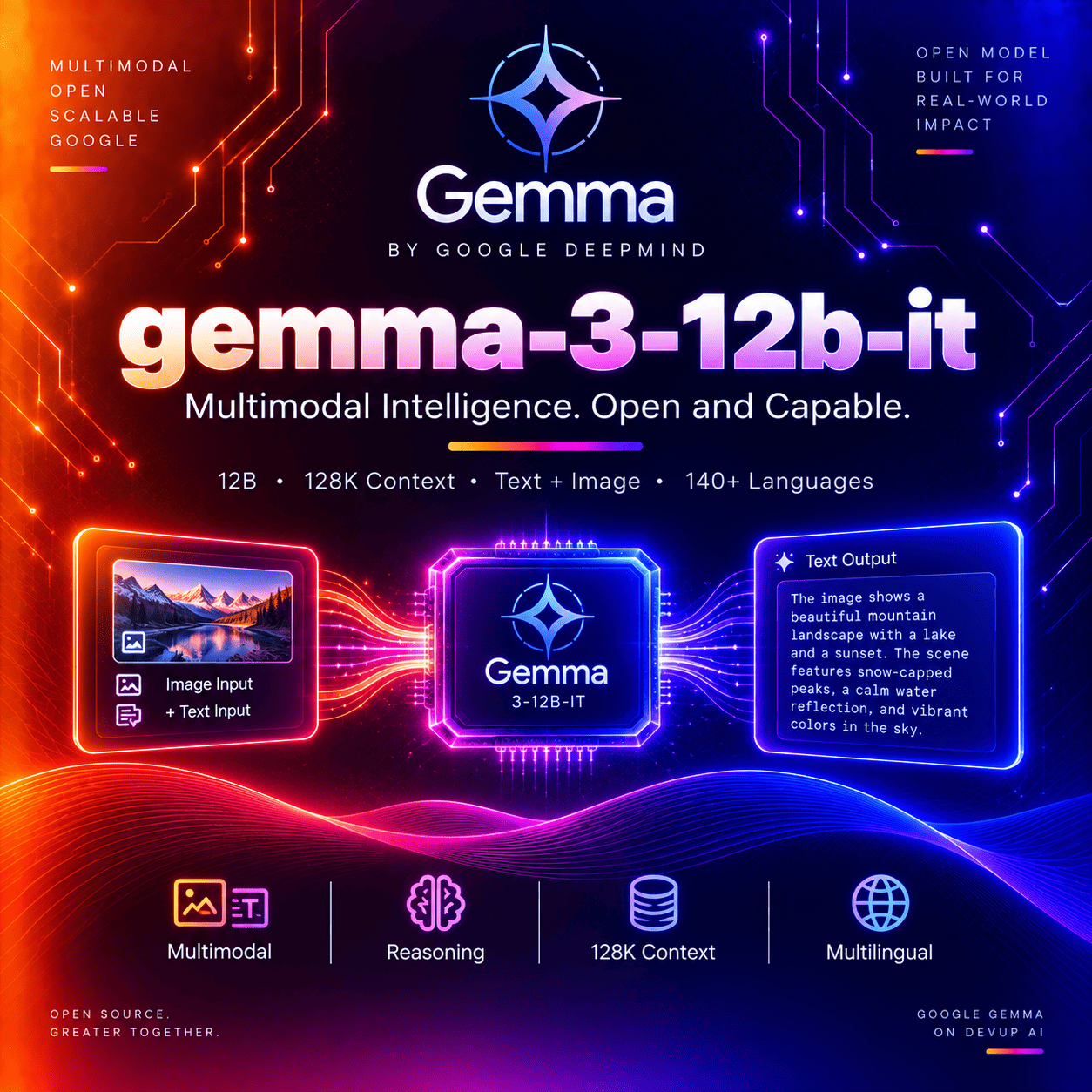
Gemma 3 12B reads images the way a person does when the print is small: it looks at the whole thing, then looks closer at the parts. Its vision encoder compresses every image into exactly 256 tokens at 896×896 — efficient, and destructive on a wide screenshot or a tall document. Pan & Scan solves that at inference time by cutting the image into non-overlapping crops and processing each separately, worth a measured 8 to 17 percent on tasks that require reading text from images. The 128K context comes from interleaving five local attention layers per global one, so only one layer in six carries a large cache, at a perplexity cost under five percent.

The llama-nemotron-embed-vl-1b-v2 is a high-performance multimodal embedding model designed to transform text queries and document images into dense vector representations for advanced retrieval systems. It excels at understanding complex visual content like charts, tables, and infographics.

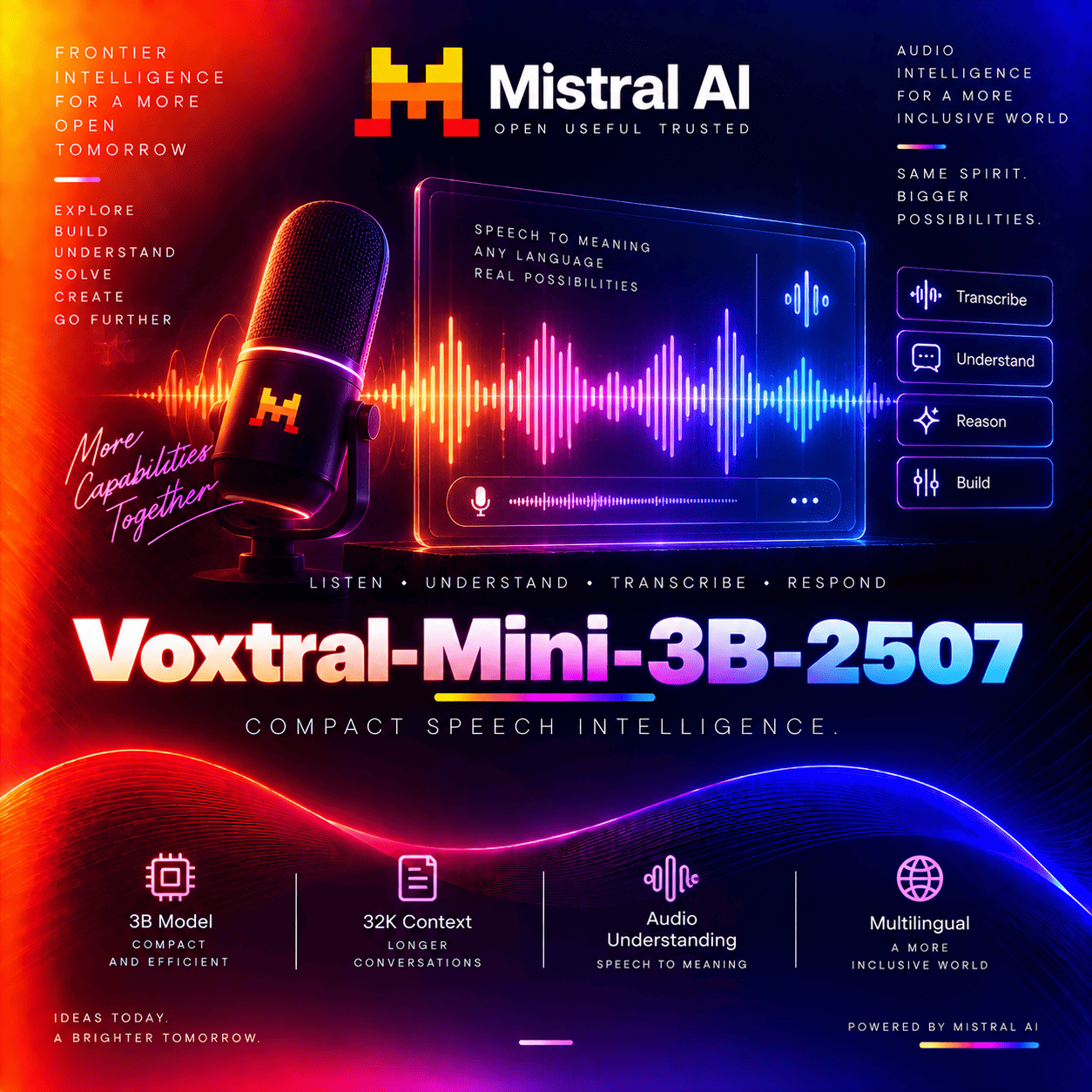
Voxtral Mini puts audio understanding on a consumer graphics card. Three billion parameters and roughly 9.5 GB of memory — against fifty-five for the larger model in the family — with the same audio feature set: dedicated transcription mode, automatic language detection across eight languages, thirty minutes of audio for transcription or forty for understanding, and function calls triggered directly from spoken intent. What you trade is the language backbone underneath. It hears about as well; it reasons about what it heard at three billion parameters rather than twenty-four.

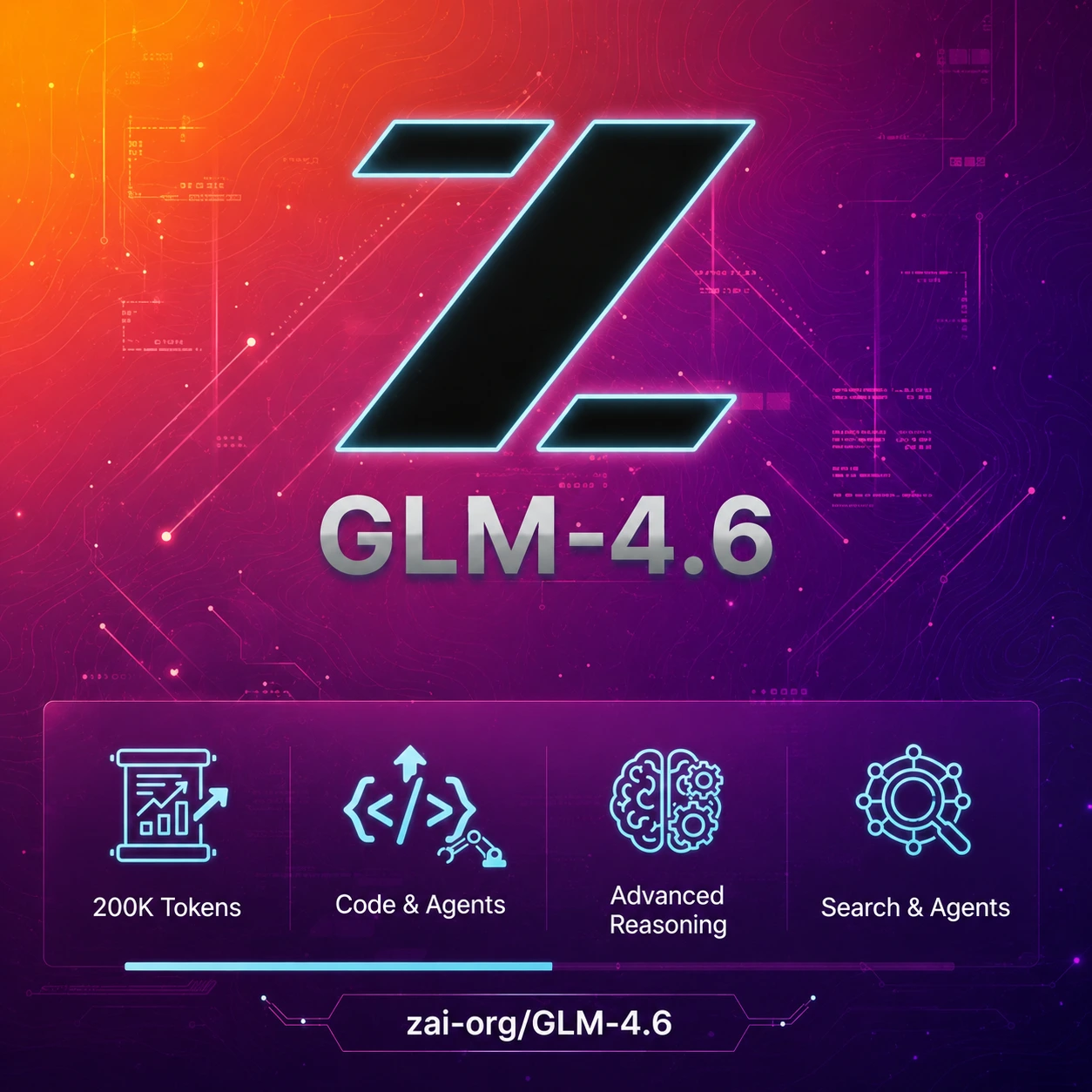
Compared with GLM-4.5, GLM-4.6 brings several key improvements: Longer context window: The context window has been expanded from 128K to 200K tokens, enabling the model to handle more complex agentic tasks. Superior coding performance: The model achieves higher scores on code benchmarks and demonstrates better real-world performance in applications such as Claude Code、Cline、Roo Code and Kilo Code, including improvements in generating visually polished front-end pages. Advanced reasoning: GLM-4.6 shows a clear improvement in reasoning performance and supports tool use during inference, leading to stronger overall capability. More capable agents: GLM-4.6 exhibits stronger performance in tool using and search-based agents, and integrates more effectively within agent frameworks. Refined writing: Better aligns with human preferences in style and readability, and performs more naturally in role-playing scenarios.
Qwen3.6-27B is a dense 27-billion-parameter model that outperforms the previous generation's 397-billion-parameter flagship on every major coding benchmark — including an eighteen-point margin on SkillsBench. It is dense by choice: no expert routing, no MoE complexity, a stack that deploys straightforwardly across llama.cpp, SGLang, and vLLM. Sixty-four layers, three quarters of them linear attention. And it introduces thinking preservation, an option to retain reasoning traces across conversation turns rather than discarding them — which on a multi-turn coding session means the model stops re-deriving what it already worked out.
Qwen3.5-35B-A3B holds thirty-five billion parameters and works three per token, across forty layers where three quarters carry sequence state at constant cost and one quarter does exact retrieval. Two hundred and fifty-six experts, nine active. A twenty-seven-block vision encoder handles images and video in the same stack, trained by early fusion rather than attached afterwards. The result is a natively multimodal model with a 262,144-token window that runs at a small model's compute — released February 2026 under Apache 2.0, across 201 languages.
Qwen3.5-27B runs Gated DeltaNet as its primary attention mechanism across three quarters of its layers, paired with sparse mixture-of-experts — which is how a model at this scale holds a 262,144-token window without the memory cost that usually implies. Its reinforcement learning was scaled across million-agent environments with progressively harder task distributions, aimed at behaviour that transfers to real workloads rather than to benchmarks. It fits on a single 80GB card at FP8, extends past a million tokens with positional scaling, and ships under Apache 2.0.
Qwen3-VL-30B-A3B-Instruct runs the same vision stack as the flagship of its series on roughly three billion active parameters. DeepStack, interleaved multi-axis positional encoding, timestamp-grounded event localisation, and OCR across 32 languages — all present, none reduced. What scales down is the language reasoning over what it sees, not the seeing itself. That combination is unusual and it decides the workload: document archives, receipt pipelines, video indexing at volume, where per-page cost determines whether the corpus gets processed at all rather than how well.
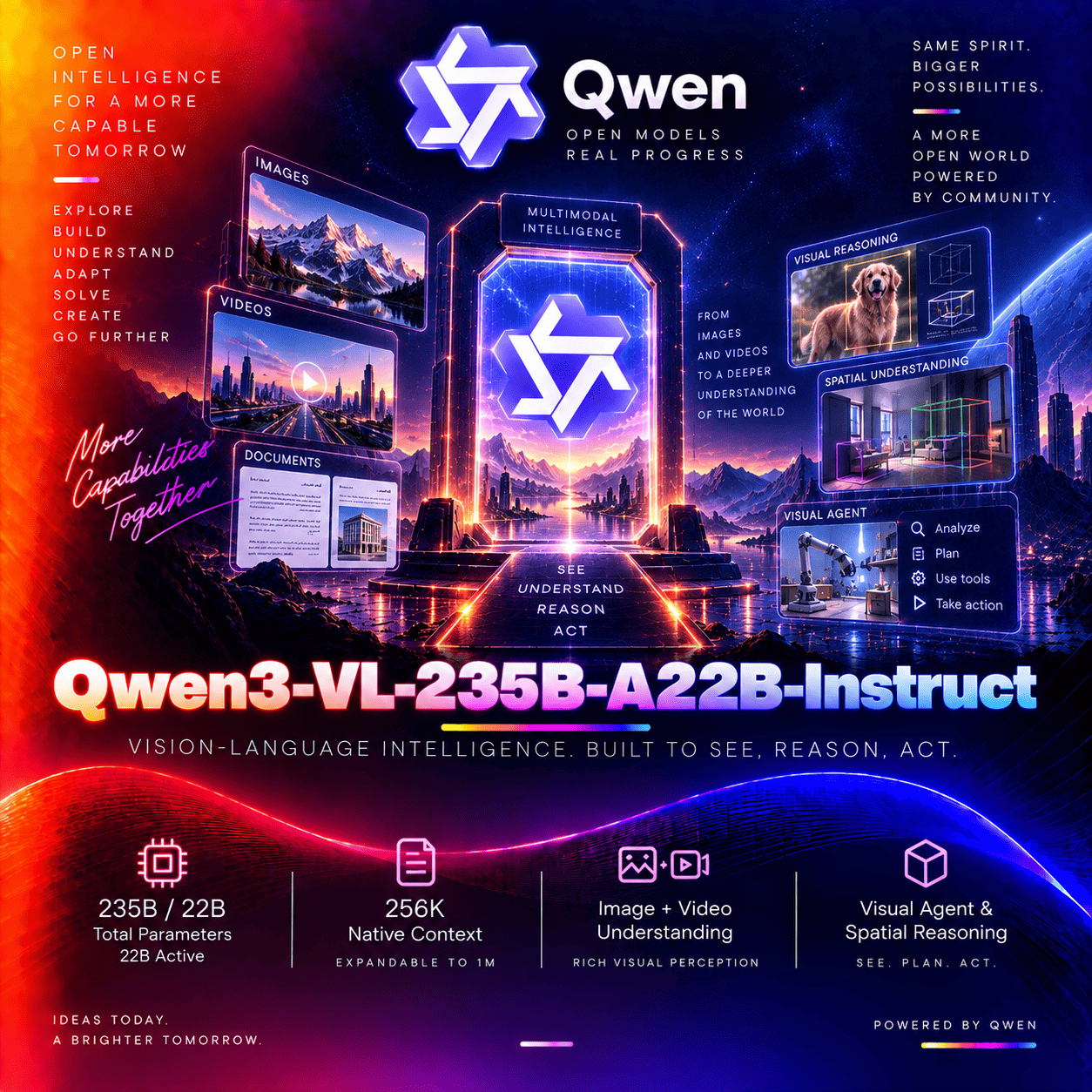
Qwen3-VL-235B-A22B-Instruct is the vision-language flagship of its series, and three named mechanisms explain what it does differently. DeepStack fuses features from multiple levels of the vision encoder rather than reading only its final layer, which is where fine detail survives. Interleaved-MRoPE allocates positional frequency across time, width, and height together for long-horizon video. And text–timestamp alignment grounds events to the second rather than to the clip. Its OCR covers 32 languages and is built for low light, blur, and tilt — real photographs rather than clean scans. It answers directly, with no reasoning blocks.

The Qwen3 Embedding model series is the latest proprietary model of the Qwen family, specifically designed for text embedding and ranking tasks. Building upon the dense foundational models of the Qwen3 series, it provides a comprehensive range of text embeddings and reranking models in various sizes (0.6B, 4B, and 8B)
The Qwen3 Embedding model series is the latest proprietary model of the Qwen family, specifically designed for text embedding and ranking tasks. Building upon the dense foundational models of the Qwen3 series, it provides a comprehensive range of text embeddings and reranking models in various sizes (0.6B, 4B, and 8B)
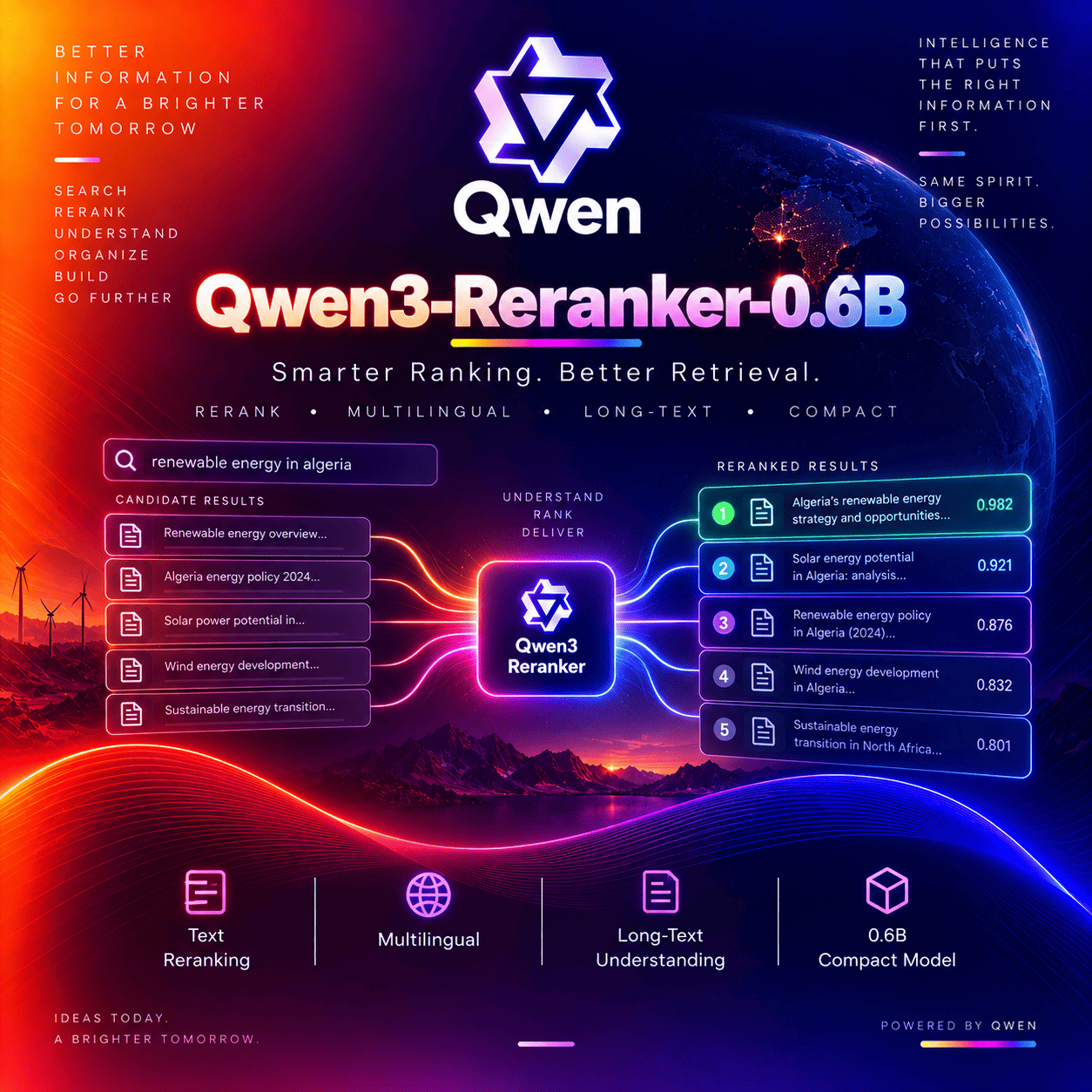
Qwen3-Reranker-0.6B scores how well a document answers a query — and it does it in a way no other reranker does. Conventional rerankers are classifiers with a scoring head. This one is a language model asked a yes-or-no question, with the relevance score read from how strongly it leans toward "yes". That design brings two things its classical counterparts lack: a 32,768-token input window, which is enough to rank whole documents rather than fragments, and support for a task-specific instruction that Qwen measure as worth one to five percent. Six hundred million parameters, Apache 2.0, and over a hundred languages.

Google DeepMind's Veo 3.1 turns a text prompt into a high-fidelity, cinematic 8-second clip with synchronized audio: dialogue, sound effects and ambient sound generated with the picture. Landscape or portrait, 720p or 1080p at the same price. The full-quality tier for final renders; draft on Veo 3.1 Fast with the same request.

Voxtral Small is Mistral Small 3 with ears. It transcribes speech, and — more unusually — it reasons about audio directly: ask a question about a recording and get an answer, without an intermediate transcript and without a second model. That removes the standard two-stage pipeline where a speech recogniser produces text and a language model reads it, along with everything lost at the handover. A 32k window holds thirty minutes of audio for transcription or forty for understanding, spoken intent can trigger function calls with no transcription step in between, and the text capability of its backbone is retained intact.


Automatically convert input text into natural and fluent speech output. You can generate natural and vivid speech content by configuring parameters such as speech style and voice. Automatically generate voices from text descriptions, without requiring presets or audio samples.


FLUX.2 [klein] 4B is Black Forest Labs' most accessible model in its fastest image family: a 4 billion parameter rectified flow transformer that generates and edits images in one compact architecture. Request any size from 128 to 1920 pixels per side, and edit with up to 4 reference images for single-reference edits and multi-reference compositions. Open weights under Apache 2.0.

FLUX.2 [klein] 9B is the flagship of Black Forest Labs' fastest image family: a 9 billion parameter rectified flow transformer with an 8B Qwen3 text embedder, step-distilled to 4 inference steps, that generates and edits images in one compact architecture. Request any size from 128 to 1920 pixels per side, and edit with up to 4 reference images for single-reference edits and multi-reference compositions.

FLUX.1 [dev] is Black Forest Labs' 12 billion parameter rectified flow transformer for text-to-image: an open-weight, guidance-distilled model with output quality second only to FLUX.1 [pro] and strong prompt following. Request any size from 128 to 1920 pixels per side, up to 4 images per request, and set the steps and guidance yourself to trade speed for detail.

FLUX.1 [schnell] is Black Forest Labs' fastest open-weight text-to-image model: a 12 billion parameter rectified flow transformer that makes high-quality images in 1 to 4 steps. Apache 2.0, priced by size and steps, up to 4 images per request.


