AI APIs & Cloud GPUs in Algeria (2026): Architecture, Real DZD Token Costs, and What to Verify
A complete 2026 guide to AI APIs and cloud GPUs in Algeria: what DEVUP AI is, how a production-grade gateway works, what a token really costs in dinars, and a 12-point checklist to verify any provider.
On this page
Choosing an AI provider in Algeria used to come down to one question: can I pay for it at all? That question has an answer now. The harder one is telling a production-grade platform apart from a marketing page, before you build your product on it.
This guide answers it with engineering, not adjectives. It explains how an AI API and a GPU cloud should be built, what a token really costs in dinars, and how to expose a misleading provider from your own terminal in five minutes. Every claim about DEVUP AI below links to a public page you can open and verify. Verify, don't trust.
What is DEVUP AI?
DEVUP AI is an AI infrastructure platform based in Algiers, Algeria. It gives developers and companies one API for more than 200 AI models, on-demand GPU and CPU servers, and developer tools such as the DEVUP Code editor extension. Everything is billed in Algerian dinars from a prepaid balance.
| DEVUP AI at a glance | |
|---|---|
| What it is | AI inference API, GPU and CPU cloud, and developer tools |
| Based in | Algiers, Algeria. Support, security reviews and billing disputes are handled directly by DEVUP AI in Algeria |
| Payment | Algerian dinars, topped up with BaridiMob, CIB or Edahabia. No foreign card |
| Pricing model | Pay as you go, no monthly subscription, free starter credit for new accounts |
| API | https://api.devupai.com/v1, compatible with the OpenAI format, plus the Anthropic Messages API and a native API |
| Models | More than 200: text, reasoning, image, video, speech, embeddings, reranking |
| Compute | More than 30 GPU models and CPU instances, billed per second |
| Developer tools | DEVUP Code for VS Code, Cursor and Antigravity; the official devupai Node.js SDK; a Playground |
| Data | Chat prompts and replies are not stored; no training on customer data |
| Public records | Docs, status page, changelog, rate limits |
The 60-second summary
Start with zero commitment. Every new account gets a free starter credit, with no deposit. There is no monthly subscription: you pay per request from your dinar balance.
One API, every modality. Text, reasoning, images, video up to 4K with sound, speech-to-text, text-to-speech, embeddings and rerankers, each listed with its price on the pricing page.
API and GPUs are billed separately. API calls are billed for what you request. GPU and CPU servers on DEVUP AI Compute are billed per second. Using the API never costs you anything for the GPU cloud.
Native developer tools. The free DEVUP Code extension, the official Node.js SDK, and compatibility with the OpenAI and Anthropic formats, so tools like Claude Code run on your dinar balance.
Audit us like you'd audit anyone. An open-source script checks any OpenAI-compatible provider in five minutes: the model behind the name, token counts against the official tokenizer,
usage,max_tokens, streaming and context window.A public reliability record. The status page publishes 90 days of uptime for five services. On 15 November 2026 it showed 100.00% for each one.
Transparent gateway or black box?
Every AI platform sits between you and the models. What matters is what it lets you see and control.
The risk of opaque routing
Some products sell access as a fixed bundle and choose the model for you behind the scenes. For a chat app used by one person, that can be fine. For software in production, it's a risk:
Structured outputs break. A JSON schema that one model follows perfectly may come back malformed from another. If the model changes without notice, your parser fails in production.
Tool calling changes. Models differ in how they call functions, how many calls they make at once and when they stop. An agent tuned for one model can loop or skip steps on another.
You can't audit cost. If you don't know which model answered, you can't know whether the price you pay matches the work done.
What a serious team expects
A production team needs three things from the inference layer: to name the model in every request, to see which model answered, and to know what each request cost.
That's how the DEVUP AI API works. You send requests to https://api.devupai.com/v1 with the model you chose, and the response tells you exactly what was used. Each response carries a request id for support, and the docs describe every endpoint, parameter and error code. Rate limits are published too: requests per minute and concurrent requests per account are listed on the rate limits page.
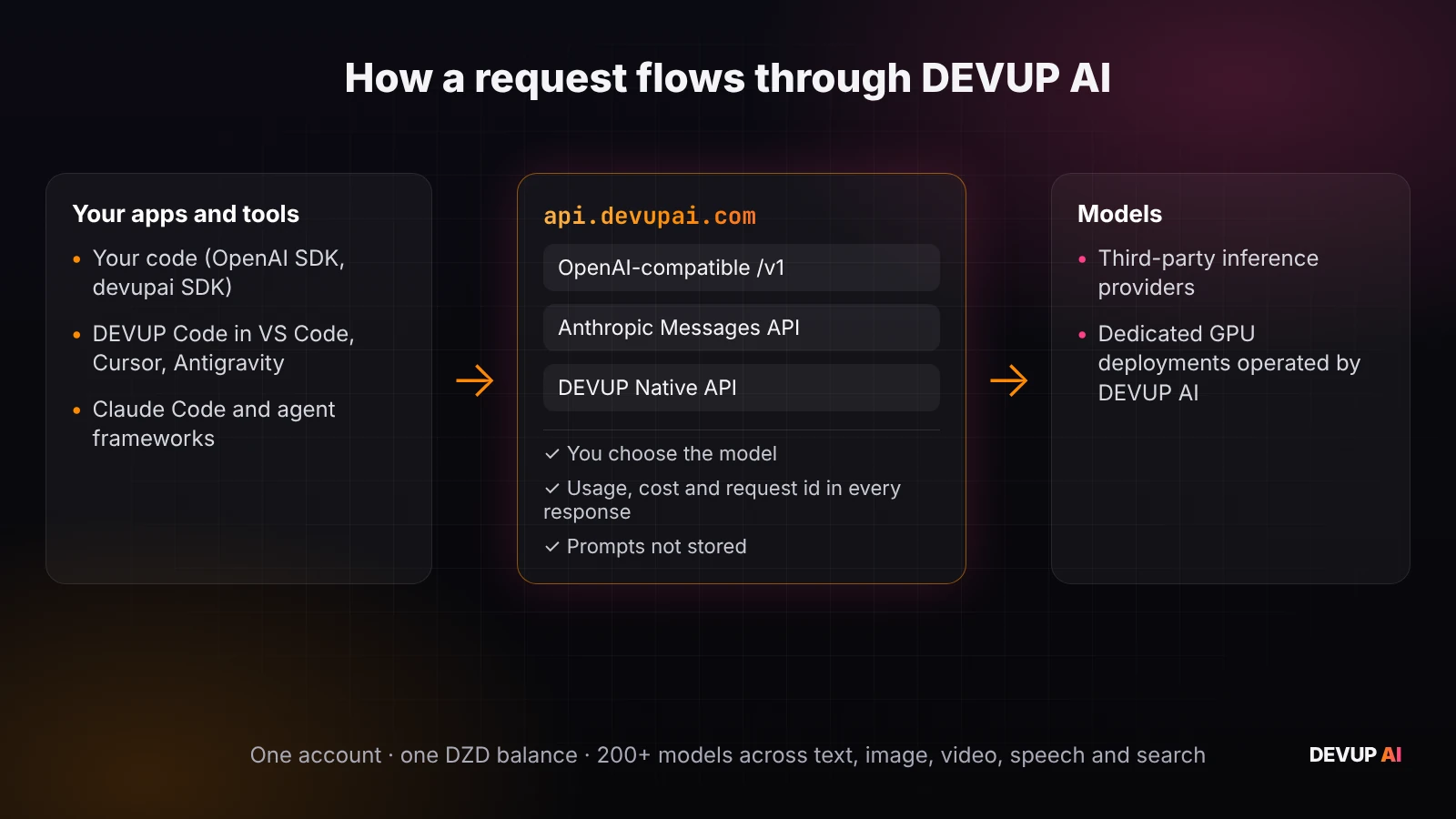
Behind the API, DEVUP AI is open about where models run. Most models are served by third-party inference providers. Selected models run on dedicated GPU deployments that DEVUP AI provisions and operates on infrastructure rented from cloud providers, as the Terms and the Security page state.
Intelligence that chooses a model for you belongs in a layer you control: an agent in your own code, or the Agent tab in DEVUP Code, where you see each file it reads and approve each change. Frameworks such as LangGraph, CrewAI or n8n connect to the same API with one setting, and more than 35 integration guides show how.
What does a token really cost in dinars?
Compare the same model, or compare nothing
A price per million tokens means nothing until you fix the model. Prices vary enormously between model tiers, even from the same model maker. In the reference table below, the most expensive output price is 500 times the cheapest, and that gap comes from the models themselves, not from any platform.
So when you compare two offers, check that both quote the same model, same tier, same unit. A frontier model on one side and a small open model on the other isn't a price comparison.
Reference table
Every price and count in this guide sits in this table, read on the pricing page, the Compute page and the docs on 15 November 2026. The last row comes from Anthropic's Claude Code costs page, read the same day. Prices and the catalog change over time: the live pages are always the reference.
| Item | Unit | Input | Output | Cached input |
|---|---|---|---|---|
| Models in the catalog | on this date | 219 | ||
| GPU models to rent | on this date | 32 | ||
| Integration guides in the docs | on this date | 36 | ||
| Starter credit for new accounts | one-time | 50 DZD, valid 7 days | ||
| Monthly subscription | per month | 0 DZD | ||
Meta-Llama-3.1-8B-Instruct-Turbo | 1M tokens | 7 DZD | 14 DZD | — |
Mistral-Nemo-Instruct-2407 | 1M tokens | 7 DZD | 14 DZD | — |
gemma-4-31B-it-turbo | 1M tokens | 42 DZD | 129.5 DZD | — |
gemma-4-31B-it | 1M tokens | 70 DZD | 140 DZD | — |
DeepSeek-V4.1-Flash-1017 (1M context) | 1M tokens | 70 DZD | 210 DZD | 2.1 DZD |
claude-sonnet-5-5 | 1M tokens | 700 DZD | 3,500 DZD | — |
claude-opus-5-5 | 1M tokens | 1,400 DZD | 7,000 DZD | — |
embeddinggemma-300m | 1M tokens | 0.65 DZD | ||
bge-m3 | 1M tokens | 5 DZD | ||
whisper-large-v3-turbo (speech to text) | minute | 0.07 DZD | ||
sdxl-turbo (image) | image | from 0.07 DZD | ||
LTX-2.5-Pro (video with sound) | second | 42 DZD (720p) to 136.5 DZD (4K) | ||
| CPU instance, 2 vCPU / 4 GB | hour, billed per second | 21 DZD | ||
GPU RTX 2000 Ada 16 GB | hour, billed per second | 84 DZD | ||
GPU RTX 4090 24 GB | hour, billed per second | 312 DZD | ||
GPU RTX 5090 32 GB | hour, billed per second | 487 DZD | ||
GPU H200 SXM 141 GB | hour, billed per second | 1,852 DZD | ||
GPU B300 288 GB | hour, billed per second | 3,147 DZD | ||
| Claude Code, average cost per developer in enterprise deployments (Anthropic) | per active day / per month | about 13 USD / 150 to 250 USD |
Prompt caching: the saving most teams miss
Coding agents and support bots resend the same large prefix with every request: the system prompt, the rules, the documents, the codebase context. On models that support it, that repeated prefix can be read from cache at a much lower price.
In the table, cached input costs 97% less than standard input on DeepSeek-V4.1-Flash-1017. DEVUP AI measured it on 16 November 2026: the same 6,429-token request sent twice, with 6,400 tokens read from cache on the second call, cut its input cost by about 96%.
Take a coding agent that sends a 50,000-token codebase context followed by a 2,000-token question. If every prefix is a cache hit on DeepSeek-V4.1-Flash-1017, the input cost of each request drops by about 93%: 96% of its input tokens are read at 3% of the standard price.
Two rules decide how much you actually save:
Put stable content first. Instructions and documents go at the start, the user's question at the end. Keep the prefix byte-for-byte identical: a timestamp at the top breaks the cache.
Measure, don't assume. A cache hit is likely, not guaranteed. Read the usage returned with each response to see how many input tokens were cached.
On supported models you can also request 5-minute or 1-hour retention explicitly with prompt_cache_key and prompt_cache_options, as the prompt caching docs explain. This cache stores the exact prefix you sent. That's different from a semantic cache, which returns an older answer to a "similar" question and can serve out-of-date facts.
For chat completions, service tiers add one more lever: Priority for faster processing, or Flex for a lower price when a workload can wait.
Am I paying for GPUs if I only use the API?
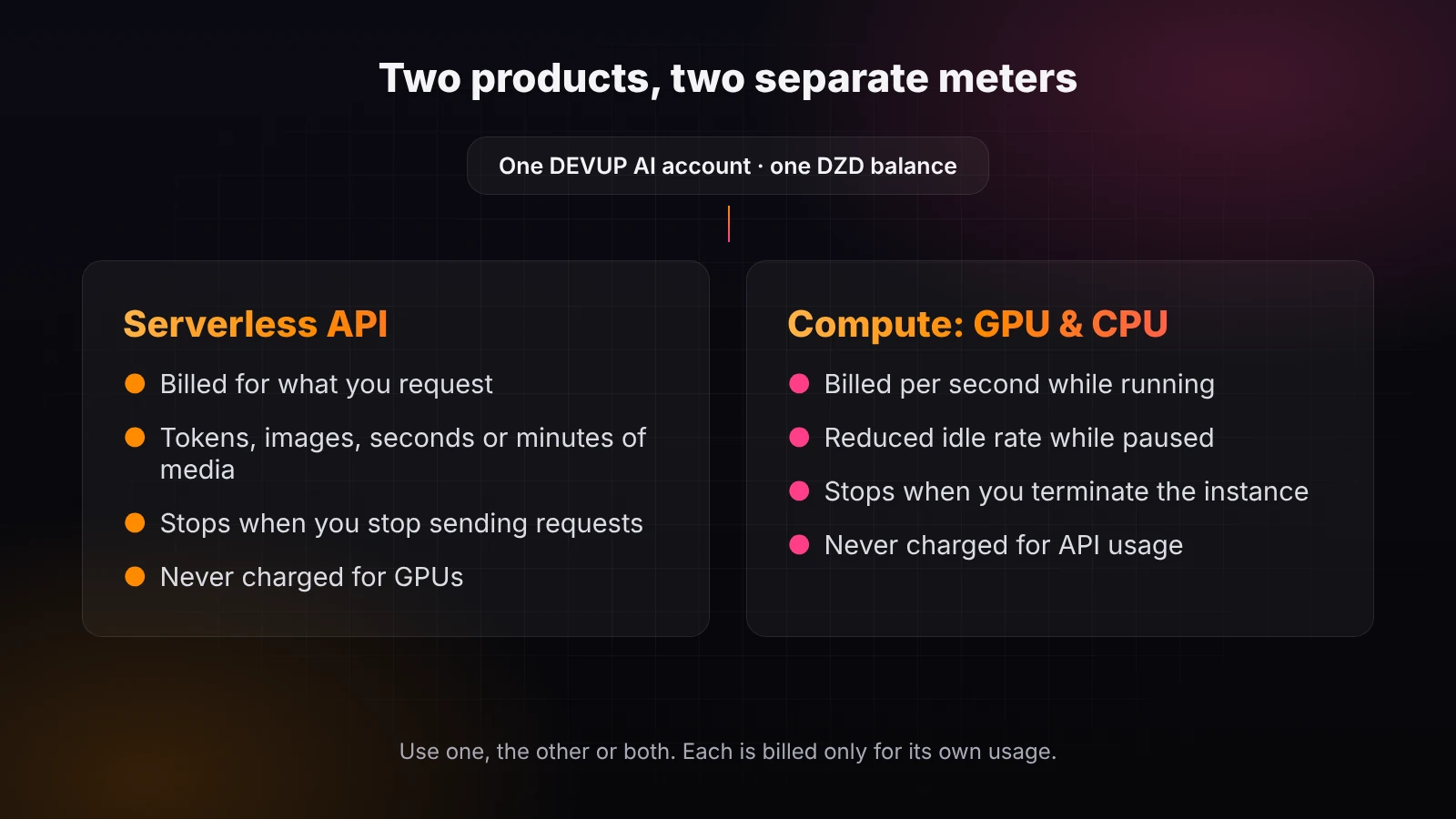
No. The API and the GPU cloud are separate products on the same account, billed separately.
| Serverless API | Compute (GPU and CPU) | |
|---|---|---|
| What you call | POST /v1/chat/completions, /v1/embeddings, /v1/images/generations… | A server you deploy: SSH, JupyterLab, your own containers |
| What you pay for | The tokens, images, seconds or minutes of media you request | Time the instance exists: per second while running, a reduced idle rate while paused |
| When billing stops | When you stop sending requests | When you terminate the instance |
| Cost for the other product | Nothing | Nothing |
When the GPU cloud becomes useful
The day your project needs more than API calls, you don't change provider or look for a foreign card. From the same account and the same dinar balance, you can:
fine-tune a model on your own data, such as LoRA training on Algerian Darija;
run your own model server or a batch job;
keep datasets and checkpoints on persistent Network Volumes that move between GPU and CPU instances.
The Compute catalog offers more than 30 GPU models, from RTX 2000 Ada to H100, H200, B200, B300 and AMD MI300X and MI350X, most of them available as multi-GPU instances, plus CPU instances in compute-, memory- and general-purpose sizes. Instances are provisioned automatically from your dashboard, with your SSH keys and an official JupyterLab template. They run on third-party cloud infrastructure in several regions outside Algeria, as the Compute page states.
Beyond chat: the full developer stack
DEVUP Code: an AI coding agent in your editor
DEVUP Code is the official extension for VS Code, Cursor and Google Antigravity, published on the Visual Studio Marketplace and on Open VSX by a verified publisher.
One-click sign-in. You approve access on devupai.com, and no API key is copied into the editor.
An Agent tab with four modes: Ask, Plan, Ask before edit and Edit automatically. Every proposed change opens as a diff you accept or reject, and Restore files returns a reply's files to their earlier state.
Secret files stay out.
.envfiles, private keys, certificates, SSH and Git folders never appear in search and can't be attached.Project rules from
AGENTS.mdand.devupai/rules.md.An Arabic interface, right to left, with code and file names kept left to right.
The full tour is in our DEVUP Code guide.
Standard APIs, so your tools already work
OpenAI-compatible: Chat Completions, the Responses API, embeddings, images and audio. Change the base URL and your existing code runs.
Anthropic Messages API at
/anthropic/v1/messages, which lets Claude Code run on your dinar balance.DEVUP Native API for any model, with signed webhooks (HMAC-SHA256) for long jobs.
The official Node.js SDK,
devupai, on npm. In Python, the official OpenAI library works by changingbase_url.Scoped JWTs: short-lived tokens limited to the models you choose, with an expiry from 1 hour to 90 days and a spending cap in dinars. Hand one to a front end, a contractor or a hackathon team without exposing your account key (authentication docs).
A Playground to try any model before you write code (Playground docs).
Every modality in one account
| Need | Examples on DEVUP AI |
|---|---|
| Text and reasoning | Claude, GPT, Gemini, DeepSeek, Qwen, Kimi, GLM, Llama, Mistral, Gemma |
| Images and editing | FLUX-2-max, gpt-image-2.6, sdxl-turbo, Qwen Image, Seedream |
| Video with sound | LTX-2.5-Pro up to 4K, veo-3.1, Wan3.0-Video |
| Video tools | video_increase_resolution, up to 8K |
| Speech to text | whisper-large-v3-turbo, NVIDIA Nemotron ASR |
| Text to speech | Multilingual and voice-cloning TTS models |
| Search and RAG | Embedding models and cross-encoder rerankers |
What teams build with it: AI APIs paid in dinars for any app, a customer support bot that answers in Darija, and coding agents in the editor.
Is my data safe? Not storing beats masking
Two approaches to privacy exist on AI gateways.
Store and mask. The gateway keeps request logs and replaces detected personal data with tags such as [NAME] or [PHONE]. It sounds safe, but it has two engineering limits in Algeria:
Detection depends on patterns. Names, addresses and phone numbers written in Darija, in Arabic script or in Arabizi (
3andi,wach rak) slip past rules built for English.When a request exists to process that data (extracting fields from an invoice, formatting a customer record, fixing a JSON payload), replacing values with tags corrupts the result.
Don't store. On DEVUP AI, chat prompts and replies pass through without being stored. DEVUP keeps billing metadata only (model, tokens, cost) and never trains models on your data, as the privacy policy states. Open-weight models are processed under terms that prohibit training on your content; for proprietary models, the model maker's own data policy applies. Data that was never stored can't leak from a log.
DEVUP AI also aligns its data handling with Algerian Law 18-07 on personal data protection, and acknowledges the oversight of the national authority (ANPDP), as described on the Compliance page.
How to expose a misleading AI provider in five minutes
A pricing page can say anything. An API can't hide much from someone who knows what to measure: the models it lists, the tokens it counts, the limits it enforces. Every check below runs from your own terminal, with your own key, against any provider. Run them against DEVUP AI too. That's the point.
Seven red flags
| Red flag | What it usually hides | How to check |
|---|---|---|
| A flat monthly price for frontier models, with "unlimited" use or limits nobody writes down | Hidden caps, a cheaper model behind the name, or shared accounts (see the math below) | Ask for the exact limits in writing, then run the audit |
| A closed model sold well below its maker's own list price, on input and output alike | The margin has to come from somewhere: a substituted model, shared consumer accounts, or a subsidy that will end | Compare with the maker's official pricing page, then run the tokenizer check |
Responses without usage, or no way to see what each request cost | You can't audit your own bill | Check 3 of the audit |
A model advertised on the site but missing from /v1/models, or responses that name another model | Model substitution | Checks 1 and 2 |
| Access through a shared login or a chat website instead of your own API keys | Consumer subscriptions resold to many people, against the model maker's terms. Access can stop any day | Ask for API keys, scoped keys and published terms |
| A huge context window on the page, but long documents get "forgotten" | Your prompt is silently truncated, or the model can't really use its window | The opt-in context check tells the two apart: a truncated prompt is counted short |
| No published terms, privacy policy, status history or changelog | Nobody is accountable when something breaks | Look for the pages. DEVUP AI's are linked throughout this guide |
The math behind "unlimited" plans
A provider pays its upstream for every token. A flat monthly fee caps what it earns, but nothing caps how many tokens you use. Anthropic, which makes Claude, publishes what its own coding agent, Claude Code, costs per developer across enterprise deployments. The figures are in the reference table above.
If a flat plan for the same frontier models costs a small fraction of that, the difference gets paid one of four ways: usage caps you discover later, a cheaper model answering under the expensive name, consumer accounts shared between many users, or investor money until it runs out. None of them is what the buyer paid for.
Shared consumer accounts deserve a word. The subscriptions that model makers sell to individuals are licensed to one person. Anthropic's consumer terms say it plainly: "You may not share your Account login information... with anyone else." A service built on such accounts survives only as long as nobody notices it.
Pay as you go isn't a marketing preference. It's the only model where the price you pay follows the real cost of what you use.
Why the tokenizer doesn't lie
Every model family splits text into tokens with its own tokenizer, and model makers publish them: open-weight models ship their tokenizer files with the weights, and OpenAI publishes its encodings in the tiktoken library. The same paragraph, especially in Arabic or mixed Arabic and French, splits into very different token counts from one family to another.
That gives a precise test. Send the same request twice, the second time with an extra reference paragraph. The increase in prompt_tokens reported by the provider must match what the official tokenizer counts for that paragraph, within a few tokens. A provider that sells "Qwen" but counts like another family is serving another model. The same measurement catches hidden text added to your prompt that you pay for, and completion counts that don't match the text you received.
The test has two limits worth stating. It identifies the model family, not the numeric precision a model runs at. And for closed models whose tokenizer isn't public, the check to use is answer quality on your own test set.
Run the audit yourself
DEVUP AI publishes the audit script as open source: ai-api-audit, under the MIT license, in a single Python file that needs nothing but an optional tokenizer library. It contacts only the URL you give it and never prints your key. A default run sends five small requests, about 2,000 tokens in total.
| # | Check | What a FAIL means |
|---|---|---|
| 1 | The model is listed by /v1/models | You're paying for a name the API doesn't serve |
| 2 | The response names the model you asked for | Another model answered |
| 3 | Every response returns usage, and the numbers add up | Your bill can't be audited |
| 4 | Prompt tokens match the official tokenizer | Another model family is behind the name, or your prompt was rewritten |
| 5 | No large hidden text is added to your prompt | You pay for tokens you never sent (reported as a warning) |
| 6 | Completion tokens match the text you received | Output is overbilled |
| 7 | max_tokens is enforced | The spending limits in your code don't hold |
| 8 | Streaming works and reports usage | Streaming apps can't track their cost |
| 9 | The advertised context window is served (opt-in) | Long documents are silently cut. A WARN means the whole prompt arrived and was counted, but the model didn't recall it |
pip install tokenizers
export AI_API_KEY="your-api-key"
python ai_api_audit.py --base-url https://api.devupai.com/v1 \
  --model Qwen/Qwen2.5-72B-Instruct --hf-tokenizer Qwen/Qwen2.5-72B-Instruct
To audit another provider, change --base-url and --model. For OpenAI models, install tiktoken and pass --tiktoken o200k_base. Adding --context-test 100000 --yes runs the long-document check, which sends many more tokens.
Get the script: github.com/devupai-platform/ai-api-audit
DEVUP AI's own results
Run on 15 November 2026 against https://api.devupai.com/v1, with the default checks:
| Model | Tokenizer | Prompt tokens: provider / tokenizer | Completion tokens: billed / received | Result |
|---|---|---|---|---|
Qwen/Qwen2.5-72B-Instruct | official Qwen tokenizer | 325 / 325 | 61 / 61 | 9 PASS, 0 FAIL |
mistralai/Mistral-Nemo-Instruct-2407 | official Mistral tokenizer | 298 / 298 | 35 / 34 | 9 PASS, 0 FAIL |
openai/gpt-4o-mini | tiktoken o200k_base | 276 / 276 | 74 / 74 | 9 PASS, 0 FAIL |
deepseek-ai/DeepSeek-V4.1-Flash-1017 | not compared | 6 PASS, 0 FAIL |
Prompt tokens matched the official tokenizer exactly on all three models where it was compared, and completion tokens matched the text received within the one-token tolerance. The chat template added between 4 and 8 tokens, and nothing else was added to the prompt. In every run, the cost returned with each response matched the published price multiplied by the usage, to within the rounding of each charge.
Long-context check. On openai/gpt-4o-mini, a prompt of about 100,000 tokens was counted in full (99,956 prompt tokens reported), and the model recalled the passphrase placed at its very beginning. With this check added, the run gave 10 PASS and 0 FAIL.
The 3 a.m. test
A platform's size isn't measured by its office or its marketing. It's measured by what works when nobody is there to help you.
Create an account at three in the morning. A platform built to run on its own gives you, with no human in the loop:
an account and a starter credit;
an API key, or a scoped token;
a first successful API call;
a GPU server if you need one, provisioned from the dashboard.
If any step waits for a person to approve it, the platform isn't automated yet. On DEVUP AI, each of these steps is self-serve from the dashboard.
What traffic estimates can't see
Website traffic estimators measure visits to marketing pages. They can't see API calls sent to api.devupai.com, requests made from inside an editor through DEVUP Code, or SDK installs. For an infrastructure product, the website is the smallest part of the traffic.
The 12-point checklist
Ask these questions of any provider. The third column shows where to check the answer for DEVUP AI.
| # | Question | Why it matters | Where to check on DEVUP AI |
|---|---|---|---|
| 1 | Can I name the exact model in every request? | Stable outputs and auditable cost | Docs |
| 2 | Are prices public, per model and per unit? | No surprise bills | Pricing |
| 3 | Is there a monthly subscription or minimum deposit? | Pay only for real usage | Pricing |
| 4 | Can I test for free before paying? | Measure on your own workload | Pricing |
| 5 | Does cached input cost less? | The biggest saving for agents | Prompt caching |
| 6 | Are rate limits published? | Capacity planning | Rate limits |
| 7 | Is there a public status history? | Proof of reliability | Status |
| 8 | Is there a dated changelog? | Proof of active development | Changelog |
| 9 | Are prompts stored? | Privacy and leak risk | Privacy |
| 10 | Can I limit a key to some models and a budget? | Safe keys for front ends and teams | Authentication |
| 11 | Do standard tools work (OpenAI SDK, Claude Code)? | No lock-in | Integrations |
| 12 | Are the tools in official registries? | Real, installable products | Open VSX, npm |
Try it in five minutes
Your first request (Python)
from openai import OpenAI

client = OpenAI(
    api_key="sk-devup-your-api-key",
    base_url="https://api.devupai.com/v1",
)

response = client.chat.completions.create(
    model="deepseek-ai/DeepSeek-V4.1-Flash-1017",
    messages=[{"role": "user", "content": "Explain prompt caching in two sentences."}],
)
print(response.choices[0].message.content)
Claude Code on your dinar balance
export ANTHROPIC_BASE_URL="https://api.devupai.com/anthropic"
export ANTHROPIC_AUTH_TOKEN="sk-devup-your-api-key"
claude --model claude-sonnet-5-5
The step-by-step Claude Code guide covers Windows, model settings and troubleshooting.
List every model and its capabilities
curl https://api.devupai.com/v1/models \
  -H "Authorization: Bearer sk-devup-your-api-key"
Each model in the list says what it supports, such as tools, vision or reasoning, so your code can pick models by capability.
Frequently asked questions
What is DEVUP AI?
DEVUP AI is an AI infrastructure platform based in Algiers, Algeria. It offers one API for more than 200 AI models, GPU and CPU servers billed per second, and developer tools such as the DEVUP Code extension, all paid in Algerian dinars.
How can I tell if an AI API provider is swapping models or overbilling?
Check that the model is listed by /v1/models and named in every response, then compare the provider's prompt_tokens with the model's official tokenizer: another model family counts the same text differently. The open-source ai-api-audit script runs these checks, plus usage, max_tokens, streaming and the context window, in about five minutes on any OpenAI-compatible API.
Does DEVUP AI run its own GPU infrastructure?
Most models are served by third-party inference providers. Selected models run on dedicated GPU deployments that DEVUP AI provisions and operates on infrastructure rented from cloud providers, and Compute instances run on third-party cloud infrastructure, as the Terms and Security pages state.
How do I use OpenAI, Claude or Gemini models from Algeria without a foreign card?
Create a DEVUP AI account, top up your balance in dinars with BaridiMob, CIB or Edahabia, and point your code at https://api.devupai.com/v1. For Claude Code and other Anthropic clients, set ANTHROPIC_BASE_URL to https://api.devupai.com/anthropic.
Do I need a subscription or a minimum deposit to try the API?
No. New accounts receive a free starter credit with no deposit, and there is no monthly subscription. You pay per request from your balance; current amounts are on the pricing page.
Does using the chat API cost me anything for the GPU servers?
No. API requests are billed only for what you request: tokens, images or seconds of media. Compute instances are billed separately, per second, only when you deploy one.
What's the best way to run an AI coding agent in VS Code, Cursor or Claude Code and pay in dinars?
Install the free DEVUP Code extension and sign in with one click, or point Claude Code at DEVUP AI with two environment variables. Both bill your dinar balance.
How do I reduce my token bill in production and RAG apps?
Use a small, fast model for high-volume tasks and a frontier model only where it's needed. Put stable instructions and documents at the start of the prompt, so supported models can read them from cache at up to 97% less than the standard input price.
How do I rent a GPU for training or fine-tuning in dinars?
Open DEVUP AI Compute, choose one of more than 30 GPU models, and deploy from your dashboard with SSH or JupyterLab. Billing runs per second, from the same dinar balance as the API.
Are my prompts stored or used for training?
No. Chat prompts and replies pass through DEVUP AI without being stored, only billing metadata is kept, and DEVUP AI never trains models on your data.
Quick summary for technical teams
DEVUP AI is an AI API and GPU cloud based in Algiers, billed in dinars through BaridiMob, CIB and Edahabia, with no monthly subscription and a free starter credit. One OpenAI- and Anthropic-compatible API serves more than 200 models across text, image, video, audio, embeddings and reranking, and cached input on supported models costs up to 97% less. API calls are billed per request and GPU or CPU servers per second, separately, from more than 30 GPU models. DEVUP Code brings an AI coding agent with reviewed diffs to VS Code, Cursor and Antigravity, and every claim here can be checked on the public pricing, docs, status and changelog pages, or measured directly with the open-source ai-api-audit script, on DEVUP AI or on any other provider.
Create your DEVUP AI account and run your first request today.
About DEVUP AI
AI infrastructure for developers — models, compute and media APIs with local DZD billing via BaridiMob and Edahabia.
Get an API key


